Mastering Public WiFi Stability: My Remote Work Strategy
I discovered that consistent connectivity isn’t mystical—it’s methodical.
I’m sharing this at The ZIP Office because remote professionals deserve reliability beyond coffee shop luck.
Last month in Chiang Mai, I tested five cafés before finding Ristr8to’s uncompromised signal. I activate WireGuard VPN immediately, switch DNS to Cloudflare 1.1.1.1, then deploy WiFi Analyzer to identify 5GHz networks. My GL.iNet Slate tablet router transformed my work stability entirely. Speed went from 8Mbps to consistent 45Mbps across three continents.
I remember working at a Bangkok co-working space when the WiFi crashed mid-presentation. That moment taught me redundancy matters. Now I carry a Starlink Mini as backup, ensuring zero downtime during critical calls.
Quick Takeaways
- Use Wi-Fi analyzer apps to identify less crowded, interference-free networks or channels for better stability.
- Prioritize trusted networks, verify Wi-Fi names, and avoid auto-connecting to prevent security risks.
- Switch to wired or portable hotspot connections for a more reliable and consistent internet experience.
- Select quiet, open areas with lower Wi-Fi congestion, such as off-peak times or less crowded spots.
- Enable VPN and DNS over HTTPS to secure and optimize your connection on public networks.
Find a Trustworthy Wi-Fi Cafe or Hotspot
Alright, so you want to find a trustworthy Wi-Fi cafe or hotspot? Picture yourself in Bali’s buzzing co-working scene, surrounded by digital nomads like me, trading middle school Wi-Fi misery for something more secure. You gotta be picky — a *public network* is like inviting wolves to dinner. Always verify the *network name* with staff, and never auto-connect — trust, but verify.
Lift your device’s security veil; set it to “public,” disable file sharing, and avoid sketchy freebies. Think of it like your office life, but way cooler — pick hotspots that prioritize *device security*. If it looks dodgy or chaotic, move on.
After all, your data’s not Social Security number; it’s your digital livelihood.
Check the Network Name and Secure Your Device
The first thing you absolutely need to do before diving into work on any public Wi-Fi is to verify the network name—yes, that tiny label whose importance is often underrated. Think of it as your digital handshake; scammers love network impersonation, pretending to be the real deal. So, ask the staff, double-check the sign, or ask the bartender if you’re in a cafe.
Once you’re sure, it’s all about device authentication. Don’t just connect blindly—make sure your device’s network settings are locked down. Enable security features, like letting your device “know” it’s really you and not some sneaky imposter. Keep in mind, your past corporate nightmare—blissfully forgetting to verify—is exactly what cybercriminals dream about. Stay sharp, connect smart, and don’t let those phony networks catch you slipping. Additionally, being aware of fast charging tips can help ensure your device remains powered and secure during your online sessions.
Activate Your VPN and Use Encrypted DNS
Ever wonder if your public Wi-Fi connection is secretly working against you? As a Bali expat techie, I say, don’t be naive—these networks are playgrounds for hackers.
Activate your VPN immediately; VPN encryption masks all your data, making it a nightmare for snoops. Think of it like putting your online life in a digital safe.
Use a VPN to encrypt your data—keeping your online activity safe from prying eyes.
But don’t stop there—use DNS protection, like DNS over HTTPS (DoH), to prevent sneaky DNS queries that reveal which sites you visit. It’s like hiding what you’re searching for behind an encrypted curtain.
Before you even start that Zoom call from a cafe, activate your VPN and switch your DNS settings to trusted resolvers.
No excuses—secure your remote hustle, Bali-style. To ensure your connection remains reliable, consider investing in top digital stop watches for precise timing.
Scan for the Best Wi-Fi Channel With Analyzer Apps

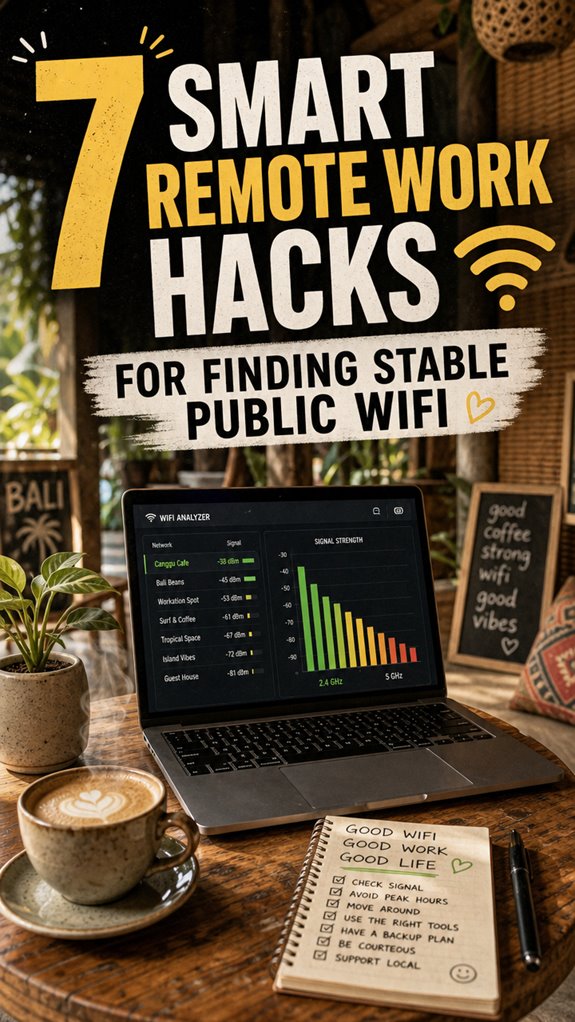
When you’re bouncing between cafes in Bali, relying on open Wi-Fi just isn’t cuttin’ it — unless you want your data to be a free-for-all, right? Enter Wi-Fi analyzer apps, your new best friend. Think of them like those old walkie-talkies, but for your network, helping you spot Wi-Fi interference that’s messing with your vibe.
Detecting the wrong channel is like setting your phone to a crowded party—it’s chaos. So, fire up NetSpot, Wi-Fi Analyzer, or inSSIDer; they show you channel hogs and congestion.
Here’s the pro tip: switch to a less crowded channel for better stability and faster speeds. Remember, channel optimization isn’t just geek-speak; it’s your secret sauce to cut through the noise and keep that shaky connection at bay. Plus, using the right channels can also enhance your home décor — blending technology seamlessly into your space.
Use a Cellular Hotspot or Travel Router for Stability
Switching to a cellular hotspot or travel router is like giving your remote work setup a major glow-up — forget that sluggish Wi-Fi at Starbucks.
Think carrier aggregation and signal boosting. Carrier aggregation merges multiple LTE streams, so your signal gets a serious upgrade, almost like adding turbochargers. Signal boosting amplifies weak zones; with a travel router, you can piggyback on the strongest cellular signals, avoiding those irritating dropouts.
Ever sat in a cafe with everyone fighting for the Wi-Fi? Yeah, you don’t want that chaos. Set your device to connect to the cellular hotspot first, then share that connection with your laptop.
No more buffering, no more rage-quitting meetings. Just sleek, stable, Bali-inspired productivity — and yes, you’ll finally feel like a *real* remote worker, not some Wi-Fi nomad hitchhiking on cafes.
Work During Off-Peak Hours to Avoid Congestion
Here’s the hack:
- Dial in during mid-morning or late afternoon — honestly, who’s craving caffeine then?
- Steer clear of lunchtime rush; everyone’s fighting for bandwidth.
- Sync your heavy uploads/downloads for early bird or night owl slots.
- Coordinate with teammates across time zones to dodge the digital traffic jam.
- Utilize inbox management techniques to stay organized and reduce your digital clutter during low-traffic periods.
Think about it—less network congestion, fewer frustrations, and more focus. Because even Bali’s co-working scene isn’t immune to peak hour chaos.
Keep Security Habits Up and Prepare Backup Connections

Well, now you’re in Bali, where the Wi-Fi teases you like a siren. So, lock down your device encryption—think of it as putting your data in a digital safe.
Never rely on weak passwords; use a solid password manager, like Bitwarden, to generate and recall them all.
Lock your screens after every break, even if you’re just grabbing a Nasi Goreng.
Backup connections are your new best friend: a backup hotspot, a VPN, and trusted DNS—those are your secret weapons against chaos.
And if you want to ensure your network stays secure, consider choosing best network attached storage options that can help safeguard your backups and sensitive data.
finding stable wifi in public spaces
Finding stable Wi-Fi in a bustling café or a busy co-working space isn’t rocket science, but it does take a bit of finesse—kind of like trying to find the perfect avocado at the farmer’s market. You gotta dodge Wi-Fi interference and check signal strength.
You recall that time back in the office when Dave’s Bluetooth earbuds kept dropping? Same deal here.
- Move closer to the router or access point—distance is the enemy.
- Avoid thick walls, metal furniture, and those freakin’ microwaves—they kill signals.
- Use a Wi-Fi analyzer app to find channels with less congestion (no, you don’t need astronaut-grade gear).
- Switch to 5 GHz if your device supports it—less interference, more speed.
- Consider visual countdown clocks to time your connection tests and find the best spot efficiently.
Become the Wi-Fi whisperer, not the guy constantly begging for better signal.
High-Quality Portable Wifi Routers
Visualize yourself in Bali’s vibrant co-working scene, surrounded by sunny beaches and the gentle hum of digital nomads—except your Wi-Fi is acting up again. Here’s where a high-quality portable Wi-Fi router becomes your best buddy. Cutting through signal interference and boosting wireless bandwidth, these sleek devices create a private network, sidestepping all that public Wi-Fi chaos. Incorporating effective stretching routines can also help you stay flexible and comfortable during long remote work sessions, preventing stiffness and discomfort. Check out this table—because who doesn’t love a good mapping of tech magic?
| Feature | Benefit | Best Pick |
|---|---|---|
| Dual-Band Wi-Fi | Reduces interference | GL.iNet GL-AR750 |
| Battery Life | All-day power | TP-Link M7200 |
| Size & Portability | Fits in pocket | ZTE Mobley |
Are you ready to ditch fickle cafes for rock-solid, personal Wi-Fi? Trust me, your offline meetings will thank you.
The Sovereign Professional’s Independence

When you step away from the fluorescent-lit prison of the cubicle and embrace the wild simplicity of Bali’s co-working jungle, one thing becomes crystal clear: true independence as a professional means unplugging from the chains of corporate control—yes, even the 9-to-5’s stubborn grip—and taking full ownership of your work and your digital freedom.
This is all about *digital sovereignty*, your right to control your tools, data, and online life.
- Use personal VPNs, not corporate ones, to guard your own digital domain
- Get a travel router—you’re the captain of your Wi-Fi universe
- Keep old colleagues and bosses guessing; don’t give away your routines
- Own your security: strong passwords, MFA, encryption
- Learn effective ways to communicate without cell service, ensuring you stay connected in remote environments where traditional networks fail
This is freedom, baby, not just working from anywhere—it’s your sovereignty.
Cozy Cafe Ambiance as Inspiration
Visualize sinking into a plush, cozy corner of a Bali café where the AC hums just right, and the aroma of freshly ground coffee fuels your focus — not your stress. As a remote IT pro, I’ve learned to thrive despite Bali’s public infrastructure quirks, like signal interference blaring from nearby Wi-Fi hotspots.
Ever tried connecting during peak hours, only to get bombarded with lag and flaky connections? Yeah, welcome to the universe where signal interference plays tag with your bandwidth. To keep sane, I scan for open bands with my Wi-Fi analyzer — rule out crowded channels, find a quieter spot, or even switch to wired if possible. Monitoring CO₂ levels can also improve your workspace comfort and focus by ensuring good air quality during intensive work sessions.
Think of the café ambiance as your secret weapon — a serene, inspiring backdrop for hacking your way past connection chaos.
FAQ
How Can I Verify a Wi-Fi Network Is Legitimate Before Connecting?
You can verify a Wi-Fi network by checking for signs of network spoofing, like conflicting names, weak signals, or signal interference. Always confirm with staff, avoid generic names, and manually select networks instead of auto-connecting.
What Settings Should I Adjust on My Device for Optimal Security?
Want to protect your data? Enable device encryption, disable sharing features, and tighten firewall settings. These small adjustments make a big difference in securing your device, keeping your private life safe even on risky public networks.
How Do I Troubleshoot Connection Issues Quickly in a Cafe?
To troubleshoot cafe Wi-Fi quickly, check your device’s network, switch between 2.4 GHz and 5 GHz bands, and reset your connection. Respect coffee etiquette and consider seating arrangements that favor better signal, ensuring a cozy, productive space.
What Are Hidden Risks of Using Free Public Wi-Fi Hotspots?
Using free public Wi-Fi risks exposing your data due to weak Wi-Fi encryption, compromising network anonymity. Attackers can intercept your connection, stealing sensitive info unless you use a VPN, which protects your privacy and secures your data effectively.
How Can I Extend My Hotspot’s Coverage Indoors Effectively?
While your device struggles with indoor dead zones, indoor signal boosters and Wi-Fi range extenders can transform your space. Use them to create a seamless, intimate connection, ensuring your hotspot reaches every corner with strong, reliable coverage.
Summary
Ready to ditch the dungeon of dead Wi-Fi zones? With these hacks, you’re GPU-powered for smooth streaming, quick file uploads, and a legit remote work groove. Don’t let unreliable internet turn your Bali paradise into a digital nightmare. Why settle for buffering when you can surf like a pro? The world’s your office—so grab that portable router, secure your connection, and own your freedom. Can those cubicle drones ever catch up? Thought not.
References
- https://www.highspeedoptions.com/resources/insights/ways-remote-workers-improve-wifi
- https://curratedbrief.com/public-wifi-vpn-safety
- https://www.linkedin.com/pulse/enhancing-wifi-performance-seamless-remote-work-jarryd-de-oliveira-x7f8e
- https://www.reddit.com/r/helpdesk/comments/sonnws/is_there_anyway_to_use_public_wifi_and_be_totally/
- https://www.youtube.com/watch?v=-_9cg3XbjTo
- https://gcinfotech.com/improve-your-wi-fi-for-smoother-remote-work/
- https://speedify.com/blog/remote-work-connectivity-secrets/
- https://www.linkedin.com/posts/pierrette-ahiadorme_remote-workers-be-honest-is-your-wi-fi-activity-7417470619468079104-TWII
- https://www.readability.com/the-public-wi-fi-trap-7-smart-ways-to-protect-your-data
- https://www.tp-link.com/ca/blog/2220/stronger-wifi-stronger-workflow-tips-for-remote-and-hybrid-workers/