Medical Coverage Essentials for Digital Nomads
What keeps nomads awake at night more than timezone confusion?
Inadequate health insurance. I’m writing this for The ZIP Office because too many remote workers gamble with catastrophic coverage gaps.
During my 18 months across Southeast Asia—Bangkok, Chiang Mai, Bali—I learned evacuation costs aren’t hypothetical. My colleague Marcus faced a ruptured appendix in July 2022; his plan capped emergency transport at $3,000. Reality: $18,500. I switched to borderless coverage immediately, ensuring unlimited evacuation and routine diagnostics. Pre-existing condition clauses? Red flag. Choose plans with transparent geographic flexibility.
Last month, I witnessed Sarah’s scooter collision in Ubud. Her basic plan refused imaging costs. That afternoon crystallized everything: robust deductibles matter less than zero-restriction comprehensive coverage. She now carries dual policies—one regional Asian plan, one global backup. The small premium differential? Insurance against becoming another cautionary tale in our Slack channels.
Quick Takeaways
- Ensure your health plan has comprehensive, high medical coverage limits that include outpatient, inpatient, and emergency services worldwide.
- Verify that pre-existing conditions are covered without restrictions and choose flexible, borderless plans for seamless travel.
- Prioritize evacuation and repatriation coverage to manage high costs during medical emergencies in remote or high-risk regions.
- Select portable health plans that are adaptable and compliant with regional visa requirements for continuous coverage.
- Use reliable, multi-carrier portable Wi-Fi devices to stay connected and access telehealth services, especially in areas with limited local healthcare options.
Why High Emergency Medical Limits Are Critical for Nomads
Visualize you’re chasing the next epic sunset in Bali, feeling like an actual digital explorer, not just some office drone tethered to the grind. Now, ask yourself: what happens if you get hit with a massive medical emergency? Would your insurance even cover that?
High emergency medical limits are *the* life raft here. Without them, you risk drowning in thousands of dollars for hospital stays or even dental emergencies — yes, dental coverage counts more than you think, especially if you bite into some spicy Bali street food and break a tooth. It’s also important to consider medical coverage limits, as many plans do not provide sufficient protection for serious emergencies.
Mental health support? Often excluded in basic plans, but vital for staying sane on the road. So, don’t be that person stuck with pocket-emptying bills — check those limits. Be proactive; your freedom depends on it.
What Routine and Inpatient Healthcare Should Be Included
When you’re living the dream as a digital nomad—typing away in your Bali hammock or spilling coffee during a quick consultation—trust me, you don’t want to get caught off guard by the basics of healthcare coverage. Routine coverage needs to include outpatient care like x-rays, MRIs, and routine doctor visits. Inpatient care? Think hospital stays, surgeries, and emergency interventions—stuff that gets you off your Bali beach quicker than you can say “medical emergency.” Ensuring your plan covers recommended silicone keyboard covers can also prevent minor mishaps from turning into bigger health issues. Here’s why it matters:
| What You Need | Why It Matters |
|---|---|
| Prescription medications | For easy access to meds without drama |
| Mental health support | Mental wellness isn’t optional anymore |
How to Cover Pre-Existing Conditions Without Restrictions

Chances are, if you’re a digital nomad with a few miles on your passport—think Bali co-working fueled by questionable espresso—your pre-existing conditions might keep you up at night.
You need pre-existing coverage that kicks restriction elimination to the curb. Here’s the scoop:
- Choose expat plans like Allianz or FIGO, which are built for life’s curveballs, so your condition isn’t a ‘no-go’ flag.
- Verify policies explicitly state “no restrictions” for your condition—don’t take their word for it—read the fine print, no excuses.
- Look for flexible, borderless coverage—think IPMI—that travels with you, not some regional limitation.
- Talk to your broker or insurer directly; ask about coverage for your specific issue, and push for “restriction-free” guarantees like you’re negotiating a raise.
Opting for a plan with comprehensive coverage often involves understanding how pre-existing conditions are handled—some policies provide coverage without restrictions if properly vetted.
Freedom from silly restrictions? Yes, please.
Why Medical Evacuation and Repatriation Are a Must-Have
If you think your travel insurance covers everything down to a T, think again—especially when it comes to evacuations and repatriations. As a Bali-based IT wizard, I’ve seen buddies stranded when their policies lacked proper medical logistics. Emergency preparedness isn’t just a buzzword; it’s your lifeline in regions with sketchy healthcare. Medical evacuation can cost $50k or more—poof, gone if you’re not covered.
Ensuring your policy includes medical logistics like coordination and support can make all the difference during a crisis.
Choosing Flexible Plans That Meet Visa and Regional Requirements

- Check regional reach—some plans exclude high-cost areas like the USA or Japan. You don’t want surprises during a medical emergency.
- Prioritize visa compliance—long stays often mean visas require minimum coverage. IPMI plans handle border-crossing permissions easier than scrambling for paper.
- Opt for adjustable plans—month-to-month renewals give you flux freedom, unlike those stuck in rigid contracts like old bosses’ outdated agendas.
- Verify coverage portability—your policy should follow you across borders, not tether you to one place. You’re not a cubicle drone anymore.
Choosing Travel Insurance For Nomads
Ever wonder if your travel insurance is actually doing its job, or if it’s just there to collect dust while you’re sipping from a coconut in Bali? As an IT nomad, I’ve jumped through more hoops than old Jim Halpert trying to dodge Dwight’s pranks—especially with visa compliance procedures.
Enter choosing the right travel insurance. It’s not just about coverage; it’s about verifying your travel docs and making sure your policy plays nice with regional laws—think of it as a digital handshake with each country’s border patrol.
Double-check if your plan covers high-cost areas like the USA or Japan—nothing worse than realizing your policy’s regional reach is as limited as the office coffee pot on a Monday.
To stay ahead, familiarize yourself with digital banking options that facilitate seamless payments and expense tracking during your travels.
Get savvy, verify, and don’t let bureaucratic red tape kill your vibe.
International Travel for remote working
Picture smashing your laptop onto a Bali co-working table, feeling like a digital nomad boss after surviving the grind in a windowless cubicle—sounds pretty sweet, right?
Now, when you’re blending work and wanderlust, international travel for remote work isn’t just about booking flights. It’s about staying healthy and legal.
Here’s your checklist:
- Health screenings & Vaccination requirements: Some countries demand proof of vaccinations—yellow fever, COVID, or hepatitis. Check the regional health stats, or you’re risking quarantine or denied entry.
- Regional healthcare coverage: Confirm your insurance covers health, especially in high-cost hotspots like the US, Japan, or Canada.
- Travel logistics with a health twist: Know how to access local clinics and emergency services—save local contacts.
- Stay updated: Keep tabs on changing visa health policies—one bad step, and you’re back to binge-watching old episodes of “The Office,” not working.
Best Plans for Digital Nomads
If you’re serious about rocking the digital nomad life without sweating over travel insurance, then you need the right plans—no excuses.
As a Bali-based tech whiz, I know the drill: vaccination requirements are key, especially when bouncing between countries, and proper baggage insurance is your secret weapon for lost gear.
Skip those sketchy, short-term policies; they’re basically a waste of time.
Opt for global IPMI plans like SafetyWing or Allianz — they’re flexible, cover serious emergencies, and tick the visa box.
Think about regional coverage—if you’re eyeing Japan or Canada, verify exclusions.
Keep in mind, no one’s got time for surprise costs or bureaucracy.
Be the digital renegade who plans ahead, equipped with the best, so your focus stays on coding, crafting adventures, not dodging medical bills.
Additionally, choosing a smart battery charger can ensure your devices stay powered without hassle, especially when traveling.
Portable Wi-Fi Hotspot Device
Think getting reliable internet abroad sounds like a nightmare filled with confusing SIM cards, dead zones, and endless technical headaches? Welcome to the liberator: Portable Wi-Fi. As a Bali-based IT ninja, I swear by this life hack.
Here’s the deal:
- Choose a device with cross-platform *device compatibility*—Android, iOS, even Linux—don’t get trapped with tech that’s only half-compatible.
- Look for global coverage and multiple carrier support, especially in remote regions where standard networks falter.
- Test your *portable Wi-Fi* in advance—don’t wait for your first epic work session to realize it’s dead.
- Opt for sleek, durable models with long battery life—that’s your lifeline when you’re off-grid chasing sunset gigs.
- Remember that network coverage can vary widely depending on the region, so choosing a device with extensive international support ensures you stay connected wherever you go.
Trust me, it’s smoother than dealing with that old boss’s endless micromanaging.
Global Health Clinics Accessibility
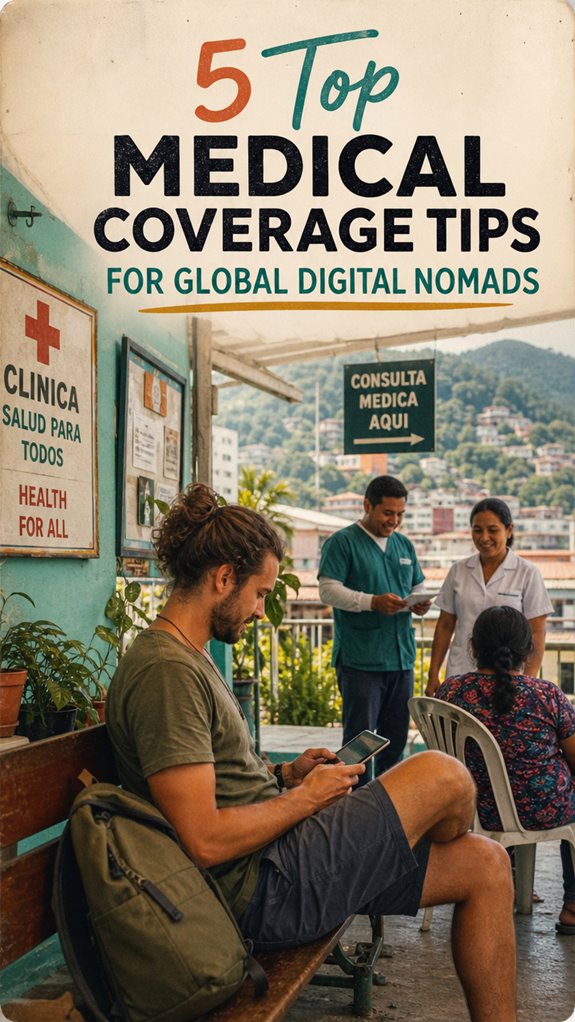
Exploring global health clinics as a digital nomad might feel like trying to find Wi-Fi in a dead zone—frustrating, but totally doable if you know the tricks. Local clinic disparities? They’re everywhere. Some countries have sleek facilities, others are rougher around the edges. Telehealth accessibility is a lifesaver, but it’s not a fairy godmother: some places still lag with digital infrastructure.
Clinic Availability & Telehealth Access
| Region | Access & Disparities |
|---|---|
| Asia | Wide telehealth adoption, but local clinics vary |
| Europe | Generally good, but rural areas struggle |
| Africa | High disparities, telehealth growing but uneven |
| Latin America | Mix of advanced clinics and basic facilities |
Pro tip: check regional health options before booking—some places are more connected than others. Just like old boss Michael, who thought he’d “run the gamut”—but ended up in a digital dead zone.
Being aware of healthcare infrastructure differences can greatly improve your experience as a digital nomad.
FAQ
How Do I Verify if My Insurance Covers High-Cost Regions Like the USA or Japan?
Think of your insurance as a high-tech shield—symbolic of a magic cloak, right?
To verify if it covers high-cost regions like Japan or the U.S., delve into the fine print—your digital scroll. Check coverage limitations, but especially look for emergency support details.
Call your insurer or check their portal. Has your policy blocked out those regions? Don’t get caught like a naive intern when real $$ hits the fan—know beforehand!
What Documentation Is Needed to Prove My Insurance Meets Visa Requirements?
You’ll need your insurance’s official Certificate of Coverage or proof of purchase—think of it as your VIP pass. It must explicitly say “worldwide coverage” without exclusions, especially for high-cost regions like the USA.
Check for policy exclusions or coverage limitations—some plans pretend to cover everything but leave out the expensive states.
Print or email these docs, because visa officers are about as forgiving as Michael Scott during a fire drill.
How Can I Compare Deductibles and Co-Pays Effectively Across Different Plans?
Policy comparison? Do it like you’re debugging old code — spotlight the key variables: deductibles, co-pays, and total cost.
Plunge into each plan’s fine print, peek at the premium vs. out-of-pocket chaos.
Think about your burnout threshold — is a lower deductible worth the higher premium?
Don’t just glance; analyze real-world cost evaluation.
Keep in mind, the goal’s freedom — not getting stuck in the hospital budget cliff like a cubicle drone.
Are Mental Health and Dental Services Typically Included in Standard Nomad Insurance?
Mental health and dental aren’t usually baked into standard nomad coverage—think of them as the exclusive club perks, often excluded.
Sure, some plans claim “full coverage,” but dig deeper; expect coverage exclusions, especially in mental health services or dental care.
If you want true travel flexibility, check policies explicitly including these get-out-of-jail-free cards.
Otherwise, you’ll be that person hauling around a hefty bill — just like stuck in the cubicle of old.
What Steps Should I Take to Ensure Coverage for Pre-Existing Conditions?
To cover pre-existing conditions, you gotta be sharp—don’t fall for Insurance exclusions. First, dig into policies—prefer plans explicitly stating coverage for your health quirks (diabetes, asthma, whatever).
Next, check waiting periods—it’s like a boring episode of The Office, but you need patience. Compare providers like FIGO or Allianz—they actually understand our nomad chaos.
Bear in mind, older or complex cases? Spend the extra bucks; it’s worth the liberation.
References
- https://www.allianzcare.com/en/about-us/blog/digital-nomad-insurance-needs.html
- https://www.digidiamo.com/health-insurance-digital-nomads-guide/
- https://estherjacobs.info/en/blog/best-health-insurance-for-digital-nomads-2023-your-ultimate-guide/
- https://www.reddit.com/r/digitalnomad/comments/1ic03ng/what_do_you_all_do_for_healthcare_as_a_digital/
- https://www.youtube.com/watch?v=UYUHrhXsinM
- https://digitalnomad.gg/guides/health-insurance-digital-nomads
- https://coratravels.com/blog/digital-nomad-health-insurance
- https://expatglobalmedical.com/travel-insurance-for-digital-nomads/
- https://nomadvisamalta.com/navigating-global-coverage-essential-health-insurance-for-digital-nomads-in-2026/
- https://nomadgate.com/primary-health-insurance-for-nomads/
- https://www.reddit.com/r/digitalnomad/comments/1cdmp2j/which_health_insurance_do_you_recommend/