Smart Travel Cash: Ditching Corporate Finance Mythology
I stopped hemorrhaging money the moment I abandoned outdated banking like my old Scranton office protocols.
I’m sharing this at The ZIP Office because digital nomads deserve fintech wisdom, not legacy bank theatrics.
Last March in Bangkok, I watched my colleague Sarah lose $47 to Dynamic Currency Conversion. I’d already switched to Wise—zero fees, real rates. I withdraw weekly in local Thai baht, use their metal card as backup, enable 2FA through Authy. Revolut handles my crypto cold wallet integration seamlessly. Expensify tracks everything; tax season becomes manageable, not catastrophic.
Last summer in Lisbon, my laptop died mid-work. My Wise metal card—durable, encrypted—kept me operational. Signal encrypted my banking conversations. N26’s biometric login prevented the nightmare scenario Dave from accounting couldn’t fathom. That moment validated every fintech migration decision I’d made.
Quick Takeaways
- Use no-fee international debit cards like Revolut or Wise to avoid foreign transaction fees and ATM surcharges.
- Always choose local currency at payment terminals to bypass Dynamic Currency Conversion markups.
- Withdraw cash in bulk from fee-free ATMs to minimize transaction costs and optimize banking networks.
- Maintain a backup metal debit card and store it separately for emergencies while traveling.
- Enable multi-factor authentication and real-time alerts to secure accounts and monitor transactions globally.
Use a No-Fee International Debit Card
No more sketchy currency booths at train stations. You’re not “roughing it”—you’re optimized.
Your cash flow should be as borderless as your Zoom calls.
And please, for the love of decentralization, stop letting banks tax your wanderlust. That’s so 2018.
You’re not a cubicle drone. You’re a sovereignty-hacking, fee-avoiding, Wi-Fi-riding nomad. Act like it.
To stay connected on the go, it’s also wise to find dependable public WiFi connections that won’t compromise your security. Additionally, using a No-Fee International Debit Card can significantly reduce conversion costs and protect your funds from unnecessary charges.
Withdraw Cash in Bulk to Reduce ATM Fees
You’re sipping cold brew at a beachfront co-working pod in Canggu, your no-fee debit card already syncing with your crypto wallet like it’s 2026 and you’re not stuck in some legacy banking purgatory—shoutout to Todd from accounting (still in the fluorescent basement at CorpCo, God help him).
Why bleed cash on ATM fees? Withdraw cash in bulk once a week—trust me, your future self’s chilling in a hammock, not stressed at another kiosk.
| Pain Point | Your Power Move |
|---|---|
| $5 ATM fees 3x/week | One $5 fee weekly = 83% savings |
| Constant cash withdrawal anxiety | Bulk pulls = freedom to focus |
You’re not Kevin with the boiled egg in Accounting. Be the Sovereign Pro who *plans*. One solid cash withdrawal beats four stupid trips. More flow, less fee.
Avoid Dynamic Currency Conversion Surcharges
When that payment terminal flashes you the “choice” between paying in local currency or your home currency, don’t just tap through like Kevin at the Schrute Farms beet auction — you’re not being offered a favor, you’re being hunted. They’re slapping stealthy currency exchange rates and hidden transaction fees on you like it’s a prank.
You used to get away with this crap in the cubicle farm, but now? You’re a Sovereign Professional. Act like one.
Skip the tourist tax with these:
- Always pick local currency (let your bank handle the conversion)
- Use a card with no foreign transaction fees
- Turn off DCC like it’s Chandler’s Joey doesn’t share food rule
- Watch for “convenience” fees disguised as “service”
For added protection, understand how paper-textured screens can sometimes mask underlying charges and make informed choices.
You’re not paying 5% more for chai in Canggu because Dave from accounting didn’t read the fine print. Stay sharp.
Choose Banks With Global Fee-Free ATM Networks
You dodge ATM fees like a pro by banking with fintechs like Revolut or Wise, tied into global fee-free networks. No more getting fleeced by sketchy currency exchange kiosks that rip you off with fake “convenience.” These spots prey on tourists who don’t know better—just like your boss.
Real move: Withdraw larger amounts less often at legit ATMs. Check for bank branch accessibility first via app maps; avoid street kiosks entirely. Using AI-driven data analysis can help identify the most cost-effective ATMs nearby. When mounting your wifi antennas on a roof, proper antenna placement ensures optimal signal strength and coverage.
You’re not just saving cash—you’re optimizing your financial attack vector. While he waits in line for overpriced rupees, you’re already surfside with cold brew and full wallet. Stay liquid. Stay free.
Carry a Backup Card for International Emergencies
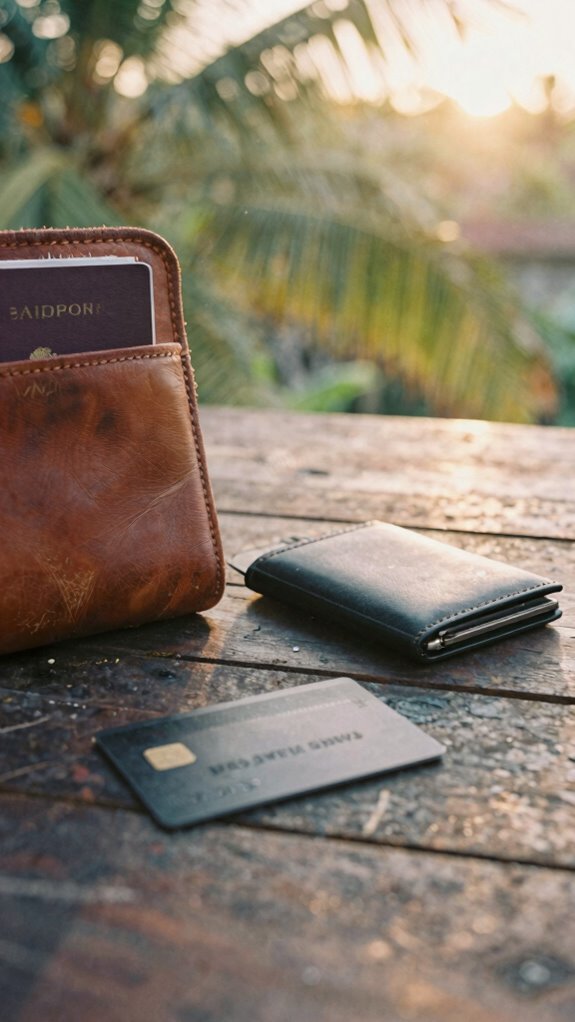
- Stash a second debit/credit card in a separate pocket.
- Use a metal card for durability—feels like armor, basically.
- Pair it with Cryptocurrency alternatives (Cold wallets = your financial BFF).
- Never store PINs together—seriously, rookie move, especially when relying on secure wall art for privacy.
- Consider a Silicone Keyboard Cover to protect your device’s keys from dust and spills during your travels.
Track Expenses in Real Time While Traveling
While your old boss from Accounting—yeah, Greg from The Office reruns he still thinks is cool—was still stapling paper receipts to expense forms (RIP, 2019), the rest of us have been running full-stack finance ops from a surf café in Canggu.
You really still logging meals on napkins? Dude, real-time expense tracking is your financial OS now. Snap a receipt, auto-categorize, done—apps like Expensify or Revolut handle currency conversion instantly, so you’re not guessing how many rupees equal one overpriced avocado toast.
Use expense forecasting to stay ahead—know what’s coming so you don’t blow your budget in Lisbon. I used to beg Greg for mileage reimbursement. Never again. Real-time expense tracking tools like these keep your financial data current, reducing errors and saving time.
Now, my data moves faster than his outdated spreadsheets. Track everything live, sync across time zones, and skip the accounting drama. And for reliable connectivity, consider low-loss coaxial cables, which ensure your signals stay clear even over long distances.
You’re not a cubicle jockey—you’re a sovereign operator. Act like it.
Pay in Local Currency for Better Exchange Rates
When you’re sipping a $3 cold brew from a Balinese warung instead of Greg’s sad office coffee that tasted like burnt gym socks, you might think you’ve already won the financial freedom game—nice, but don’t get cocky.
Your card provider’s *currency exchange* scam is still lurking. Say you’re paying in USD abroad? That’s dynamic currency conversion—a trap. You *always* want to pay in local currency.
That USD charge abroad? A scam. Dynamic currency conversion stacks hidden fees—always pay in local currency or get fleeced like a tourist.
Why? Fees are insane when the machine “helps” you “save time.” Local merchants see it too; they’ll shrug and say, “That’s how tourists get fleeced.”
Do this instead:
- Turn off “auto-convert” in your banking app
- Say “no” when the terminal asks to charge in your home currency
- Use cards with zero foreign transaction fees (N26, Revolut)
- Flash that card like you mean it—own the transaction
You’re not Greg. You’re sovereign. Act like it. Always be aware of currency exchange fees and how they impact your spending abroad.
Use High-Yield Travel Savings Accounts
Here’s the real tea: every dollar you park in a standard bank earns *nothing*—literally, zero—while inflation eats it like a slow-mo zombie snack. Stop being a human piggy bank for brick-and-mortar banks that pay you pennies.
You’re not some cubicle drone at Dunder Mifflin—wake up. Open a High yield savings account instead—like Marcus or Ally—and watch your cash actually work for you while you sip boba in Bali. These accounts regularly offer 4%+ APY, so your money grows while you globetrot.
And when you pair that with low-fee Currency conversion apps like Wise, you keep more of what’s yours. No more getting jacked by hidden bank fees.
*Recall* Dave from accounting who still uses cashier’s checks? Yeah, don’t be Dave. Your money should travel smarter than you do.
Rely on Digital Wallets Instead of Cash

You’re a sovereign pro, not some cubicle-dwelling relic. Let’s talk digital wallet management—your new financial backbone.
Pair it with cryptocurrency security, and suddenly, you’re untethered, agile, *free*.
Try this:
- Use apps like Revolut or Wise—they auto-convert currencies like magic.
- Stash stablecoins in a secured wallet—no more sketchy兑换 at Bangkok kiosks.
- Enable biometric logins—your face is your ATM now.
- Back up seed phrases offline—’cause losing crypto to a spilled boba tea sucks.
- Understand the importance of expense tracking—closely related to claiming home office expenses, ensuring you maximize deductions while staying compliant.
- Always stay informed about cryptocurrency security best practices, so your digital assets remain protected against threats.
Remember Dave from Accounting? Yeah, he’s still printing expense reports. You? You’re sipping *kopi* in Bali, one tap away from global domination. Keep moving.
Enable Multi-Factor Alerts for Overseas Security
Three layers of security beat one flimsy password—especially when you’re sipping cold brew in a Chiang Mai cafe while your bank thinks you’re still stuck in a gray cubicle in Columbus.
You *do* want alerts, right? Because overseas data breaches don’t care how chill your vibe is. Turn on push, SMS, *and* email alerts—yes, even the ones that feel excessive.
Your old boss from Tempe? Got SIM swapped in Bali. Poetic justice, but also a nightmare. Lock your number with your carrier—common move here in Canggu.
SIM swap risks are real when you’re living fast across time zones. I use Authy + biometrics—because no, Karen from accounting, your fingerprint isn’t “weird.” Top authenticator apps are crucial for safeguarding your accounts in this scenario.
Set geo-alerts too. If your card pings in Madrid while you’re Wi-Fi’ing barefoot in Ubud, your phone’ll scream.
That’s not paranoia. That’s sovereignty. Protecting your encrypted communication is just as crucial as safeguarding your physical belongings.
International Banking for remote working
Forget cubicle compliance. You need:
- A neobank with multi-currency accounts (Wise or Revolut—duh)
- Cold wallet backups for crypto payouts (because hot wallets are for interns)
- Two-factor auth *on everything*—yes, even your savings
- A local IBAN in Estonia or Spain via e-residency (so you’re taxed like a genius, not a drone)
Your salary doesn’t care about time zones. So why should you? Open a multi-currency account to streamline your global finances and capitalize on the advantages of international banking.
While Dwight was obsessed with beet farming, you’re farming high-yield EUR stables—on a beach. Now that’s progress. And secure multi-currency transactions can help you seamlessly move funds across borders, ensuring you stay ahead in the global digital economy.
Use Encrypted Mobile Banking Tools
While your old boss Dwight was still sharpening his beet-tracking spreadsheet, you’re already routing six-figure transactions from a beachside warung using nothing but a phone and some next-level encryption apps—because modern banking isn’t about branches, it’s about armor.
Your phone, a warung, and six figures—Dwight’s still stuck in Excel while you bank like a digital ninja. Armor up.
You’re not some cube farmer—your bank account needs *Encrypted bank security* that laughs at public Wi-Fi. Use apps like Revolut or N26; they bake *mobile transaction protocols* into every swipe and send.
Ever tried logging in from Canggu while your ex-coworker fights a printer? Yeah—your phone just approved a transfer with biometrics and 2FA. No dramas.
Download Signal for encrypted comms, and *always* enable push alerts. If a coffee shop network asks for your soul, say “nah.” Your money moves fast, but your security moves faster. Being aware of mobile security practices can further protect your data on the go.
And remember, using a Travel Money Card can help you manage foreign currency transactions effortlessly, providing an extra layer of secure spending abroad.
This isn’t banking. It’s digital self-defense.
The Encrypted-Phone Banker
Forget Steve in cubicle C-12 who still prints spreadsheets. You’re out here:
- Using biometric-authenticated banking apps
- Stashing crypto in non-custodial wallets
- Sending funds via decentralized mesh networks
- Logging into finance dashboards through zero-trust protocols
Your SIM is eSIM, your OS is hardened, and your Wi-Fi? Always routed through a personal 5G shield. Tony from 2019 IT would faint. But you? You’re already paid, private, and pole-vaulting past the corporate gatekeepers. Additionally, you rely on anti-fatigue floor mats to stay comfortable during your long remote work sessions.
Biometric Offshore Banking Access
You’re sipping turmeric lemonade at a bamboo-desk pod in Canggu, your face lit by the glow of three encrypted screens, and you just got paid in USDC from a client in Oslo—no wire fees, no bank holiday delays, no Greg from Accounting “approving” the transfer.
Now, you need cash. Fast. That’s where biometric authentication saves your ass. Your offshore accounts aren’t locked behind passwords or sketchy security questions like “mother’s maiden name.” Nope. Just a glance. A touch. A blink. You’re in. Think: Face ID meets James Bond vault.
You use it daily—logging in from Tbilisi, pulling funds in Manila, all seamless. Meanwhile, Dave from HR back home? Still resetting his Outlook password. Twice a week. Sad. Strong security protocols are essential to protect your digital assets, especially when using biometric data that is increasingly difficult to replicate or steal.
Biometrics mean no keys, no slips of paper, no panic when customs flips through your bag. You? You’re sovereign. Secure. Gone are the days of branch visits and forms. Your face *is* the key. And Greg? Tell him to upgrade.
And with the emergence of biometric hard drives, your data remains virtually tamper-proof, giving you even greater control over your security.
FAQ
How Do I Report Stolen Digital Funds While Abroad?
you freeze accounts fast, report digital currency scams within hours, and activate emergency fund procedures. you keep calm, document everything, and contact local cyber authorities. you don’t panic—your sovereignty depends on swift action, not luck. you’ve got this.
Can I Open Offshore Accounts Without Visiting the Country?
Yes, you can open offshore accounts without visiting—like Maya from Lisbon who did it in 48 hours. You’ll use digital banking and e-residency platforms to handle offshore investments securely, no travel needed, just your passport and a verified identity online.
What if My Biometric Banking Access Fails Overseas?
you’ve got this—biometric security glitches happen, but your digital identity stays safe. carry a backup authenticator app, use encrypted USBs, and log into your sovereign accounts with recovery codes. breathe easy, you’re still in control, even overseas.
Are Encrypted Wallets Traceable by Foreign Governments?
“Where there’s a will, there’s a way” — yes, your encrypted wallet privacy isn’t foolproof. Governments with advanced tracking capabilities can pressure providers or exploit entry points. You’re safer, not invisible. Stay low, rotate wallets, and assume they’re watching—because they might be.
How Do I Recover Access if I Lose My Security Key?
you’ve got this—use your security backup plan now. access recovery’s fast if you’ve saved backup codes or linked a trusted device. breathe, you’re not locked out. trust your prep, stay calm, and restore your access in seconds.