Smart Lighting Transforms Remote Work Focus
I ditched fluorescent hell last March.
I’m writing this for The ZIP Office because lighting fundamentally changed how I work from home. Most remote workers ignore circadian rhythms entirely—it’s costing them productivity and sleep quality.
I synced 5000K cool light to my deep work blocks at 9 AM, then shifted to 2700K amber by 3 PM. Side-placed bias lighting eliminated screen glare on my dual monitors. I layered three smart bulbs like audio engineer precision, automated dawn simulations through my Philips Hue system, and blocked blue light after 6 PM by dimming to 30%.
My Tuesday morning felt different. I’d been working under harsh overhead lights for months, squinting at Slack notifications. After installing bias lighting behind my desk, my 90-minute focus sessions doubled. My eyes stopped burning by day’s end. Small change. Massive impact.
Quick Takeaways
- Use 5000K cool lighting in the morning to boost alertness and match natural daylight for better focus.
- Switch to 3000K–4000K warm or neutral light in the afternoon to maintain concentration without mental fatigue.
- Automate lights to sync with sunrise and sunset, reinforcing circadian rhythms and improving energy levels.
- Position lights beside or behind monitors to reduce glare and avoid overhead or direct screen lighting.
- Choose flicker-free, DC-driven LEDs and dim to 30% brightness to minimize eye strain and enhance productivity.
Sync Light Temperature to Match Your Work Blocks
Look, I get it — back when I was grinding in a fluorescent-lit cubicle farm under those soul-sucking 6500K office tubes, nobody cared if my brain felt like mashed potatoes by 2 p.m.
But now? You’re the CEO of your ambient illumination. Start your deep work block with cool 5000K light — crisp, alerting, perfect for crushing code or spreadsheets.
Think of it like neural espresso. Then, shift to 3000K in the afternoon for warm, cozy focus — your brain’ll thank you.
Sync your smart bulbs to your calendar, duh. Sarah from accounting (bless her soul) still uses a desk lamp from 2012 — don’t be Sarah. Using daylight therapy lamps can help you mimic natural sunlight and boost your mood during those long work sessions.
Your color temperature isn’t just lighting — it’s cognitive infrastructure. Proper lighting routines can actually enhance your focus and reduce fatigue.
You’re not “working from home.” You’re orchestrating performance-grade environments like a lighting alchemist.
The old office? A museum of bad ambient illumination. You? You’re post-cubicle. You’re sovereign.
Now go tweak that Kelvin.
Block Blue Light at Night to Support Recovery
Protect your downtime like it’s encrypted data. Filter blue light after sunset to keep melatonin flowing and your circadian rhythm intact. Nighttime safety isn’t just about streetlights; it’s about protecting your brain’s off-switch. A hidden book safe can help you secure your personal items when you’re not using the space. Additionally, using antennas can improve your device connectivity, reducing the need for excessive screen time to troubleshoot signal issues.
Reduce Eye Strain With Layered Lighting
While your old boss back in the fluorescent-lit cube farm was probably still arguing about printer jams in 2019, you’re out here building a war room for your retinas under a Balinese palm tree—so why the heck are you letting harsh overheads murder your focus?
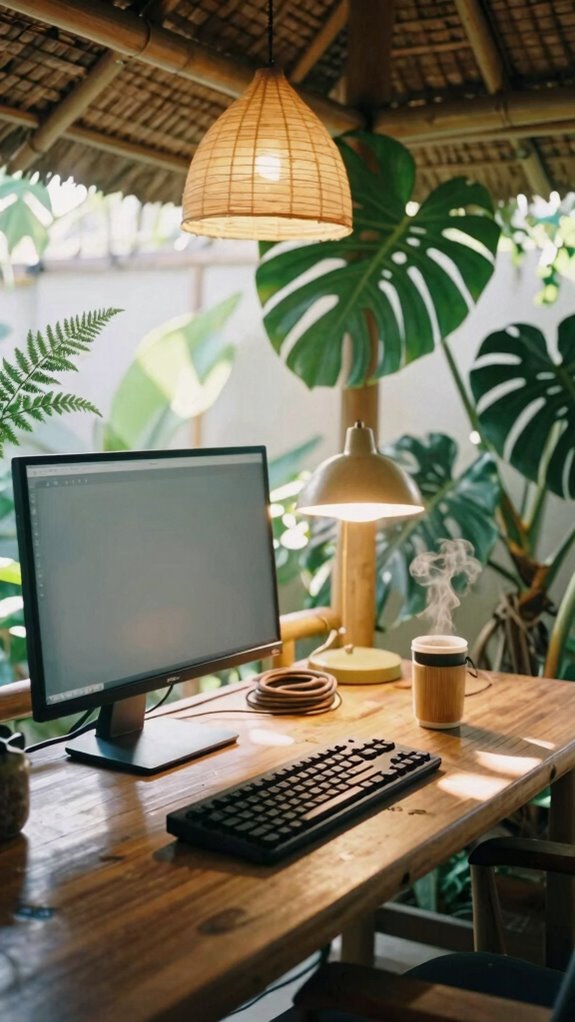
Ditch the cave-vibe glare and start layering like a pro. You want ambient glow from a floor lamp in the corner, warm task lighting on your desk, and a splash of color layering with dimmable LED strips behind your monitor. Think mood lighting meets productivity hack.
I used to get headaches by 10 a.m. in that gray cubicle jungle—now I dial in my lights like a DJ syncing a beat. Your eyes aren’t built for flat, soul-crushing ceiling floods. Create depth. Add dimension. Hack your biology.
And yeah, Steve from accounting would’ve called it “extra”—but Steve also unplugged the office router to microwave fish. Don’t be Steve.
Eliminate Screen Glare by Positioning Lights Correctly
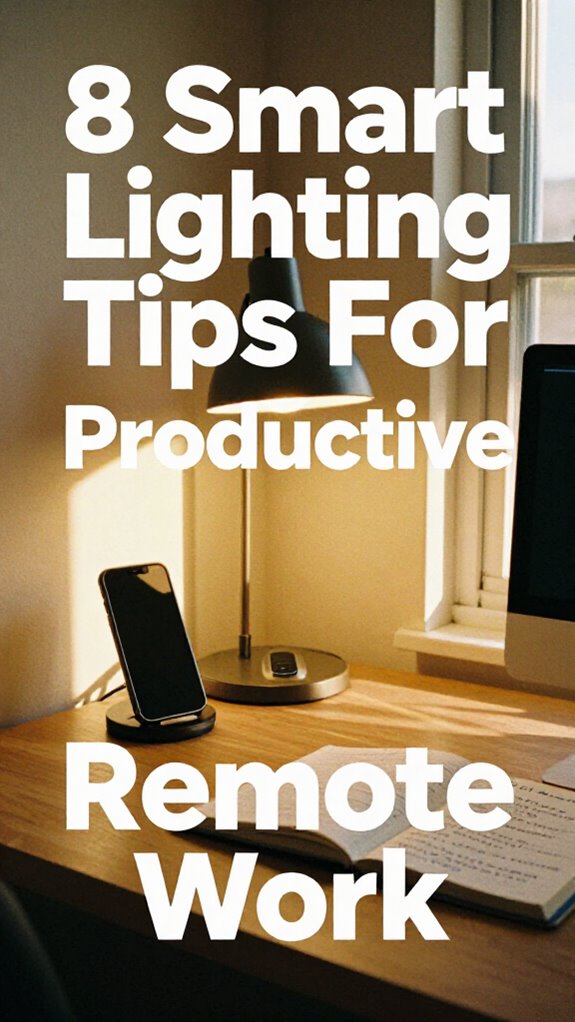
You didn’t escape the zombie apocalypse of fluorescent lighting just to recreate it in your van or Bali loft—so stop letting glare turn your screen into a greasy spoon mirror. Seriously, who wants to work like Dwight Schrute squinting at his beet spreadsheet?
You fled fluorescent purgatory—don’t let glare turn your freedom rig into a greasy diner special. Work in light that serves you, not Dwight Schrute.
Position your light sources beside or behind you—never straight on or above. That overhead chaos kills clarity. Use ambient automation to softly wash walls with indirect light, bouncing it off surfaces to kill hotspots. Regularly monitor CO₂ levels to keep the environment fresh and alert; even the best lighting setups can’t compensate for poor air quality. Incorporating sound-absorbing materials can further reduce echoes and improve overall acoustics, creating a more focused workspace.
Pair that with spectral customization—tweak your LEDs to match your screen’s color temp. No more “art gallery under interrogation lamp” vibes.
My old boss in Houston still uses LED bars like it’s it’s 2016. Sad. You’re not him. You’re sovereign. Ditch the desk lamp death ray and think indirect, intelligent, intentional.
Your eyes? They’ll thank you. Your Zoom calls? Crisper. And your brain? No longer fried by a DIY tanning bed. Win.
Boost Morning Alertness With Automated Light
5 AM.
Your body’s still asleep, but your old boss would’ve already micromanaged three Zoom calls. Not you. You’re syncing with the sun—smart. Set your lights to ramp up with natural illumination, mimicking dawn. No more jolting awake like a vampire in a spreadsheet.
You want that color temperature to shift from warm (think candlelight) to cool blue (like midday sky) by 7 AM. It tells your brain: *hey, we’re alive now*.
I use a $30 smart bulb and an app that auto-does this—game changer. No more stumbling into the “office” (aka my balcony in Bali) half-dead. For optimal results, ensure your lighting setup mimics natural daylight patterns as closely as possible, which can significantly impact your circadian rhythms.
Cubicle drones? They need fluorescent abuse. You? You’re running circadian tech like a biohacker.
Pro tip: pair it with sunrise alarms. Boom—alertness without the caffeine panic.
Want to make sure you’re starting your day with optimal light? Finding stable public WiFi(Tips-for-Securing-Reliable-Public-Wifi-Connections) can help you stay connected seamlessly as you adjust your lighting setup outdoors.
You’re not working *in* nature.
You’re working *with* it.
Focus Better With Task Lighting in Key Areas
Mornings sorted? Good. Now let’s laser-focus your workspace, because ambient shadowing is the silent killer of clarity—seen it in every cubicle back in the day. You’re not chained to a fluorescent prison anymore. Kill the flat light. Bring in task lighting where it matters: desk, screen, hands-on-keyboard zones.
Use color contrast to hack your brain into “deep work” mode:
- A warm desk lamp for your notebook—no more squinting at code like my old boss did.
- Cool bias lighting behind your monitor—cuts eye strain, boosts contrast.
- Directional under-shelf LEDs to eliminate ambient shadowing—BAM, instant dimension.
Remember Jerry from accounting? Still uses a dingy 60W bulb.
Meanwhile, you’re out here lighting like a pro in a Bali co-working loft. This isn’t lighting. It’s focus infrastructure. Own it.
Choose Flicker-Free LEDs to Maintain Mental Clarity
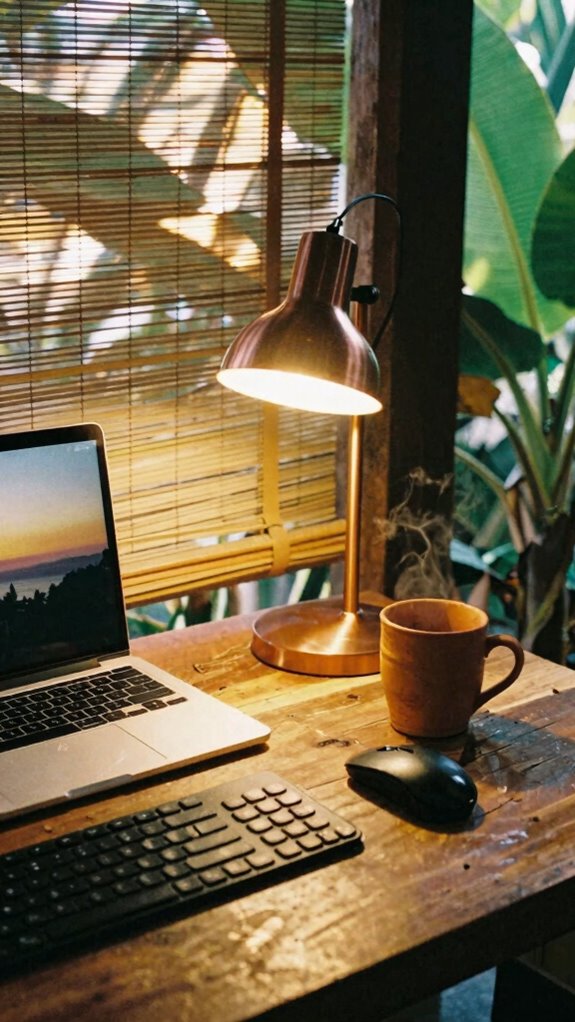
While your old boss was back in the office squinting at spreadsheets under humming, flicker-heavy fluorescents—probably wondering why his headache wouldn’t quit—you’re out here building a focus fortress in a Balinese treehouse with lighting smarter than Dwight’s beet farm security system.
While your old boss battles fluorescent headaches, you’re engineering peak focus in a Balinese treehouse—lighting so sharp, it outsmarts farm-town security systems on a slow Tuesday.
You already killed ambient glare, so now level up: swap every bulb for flicker free LEDs. Those cheap diodes? They pulse faster than a panic-stricken intern, wrecking your mental clarity without you noticing.
I learned this after three migraines in Canggu—turned out my “cool vibe” strip lights were actually strobe-lit anxiety traps. Flicker stresses your brain like mandatory fun at corporate retreats.
Go for DC-driven LEDs or brands like Philips or Nanoleaf—they don’t cut corners. Your cortex isn’t a cubicle-dweller. Treat it like elite infrastructure.
One switch, zero flicker, total focus. Boom—neuro-resilience accessed.
Use Dimming to Trigger Deep Focus Mode
Try this:
- Drop brightness to 30% to trigger focus mode
- Boost color contrast with warm tones (2700K) to reduce eye strain
- Pair with blackout shades so glare doesn’t ruin the vibe
It’s not ambiance—it’s attention hacking. My old boss thought noise-canceling headphones were “excessive.” Joke’s on him—he’s still trapped in meeting purgatory.
Meanwhile, I’m here in Bali, shadows hugging my screen, crushing code like a nocturnal genius. Dimming isn’t a setting. It’s a signal: *work is sacred*.
For precise timing, consider a digital stopwatch to optimize your focus intervals and breaks. Remember, proper lighting design can significantly impact productivity and mood.
Now go darken that room and disappear into the zone.
The Performance Biohacker Style
You control color dynamics like a pro DJ: cool blues at 9 a.m. to crush code, warm amber by 3 p.m. to avoid mental meltdown. Ambient glow? That’s your recovery signal—think post-sprint cooldown, not cubicle cozy.
I used to stare at flickering office fluorescents while Dwight yelled about beets. Now? My desktop red light panel charges my mitochondria like a Tesla. Incorporating library etiquette ensures your workspace remains respectful and efficient, even in virtual environments.
Pair it with a smart bulb set to mimic sunrise, and boom—your brain thinks it’s living its best Alpine life. You’re not working harder. You’re *engineering* focus.
The cube farm’s still stuck in 2012. You’re running edge-AI-level ops from a laptop in Bali. Stay sovereign. Stay lit—literally. Incorporating load balancing routers into your setup can ensure your network stays fast and reliable, even during peak usage.
Ergonomic Lighting for Circadian Alignment
- Morning: Crank 5000K cool light to mimic sunrise
- Afternoon: Shift to neutral 4000K for steady focus
- Evening: Warm it down to 2700K to protect melatonin
Pair this with motion-triggered dimming and your Bali-style workflow stays elite—no more zombie mode by 3 PM.
Motion-triggered dimming keeps your rhythm sharp—Bali-level focus without the 3 PM crash.
You’re not an office drone. Act like it.
Circadian-Synced Lighting Systems
While your old boss from 2022 still thinks ‘office lighting’ means flickering fluorescents that make everyone look like zombies from The Office, you’re out here syncing your bulbs to the damn rhythm of the sun—because your brain didn’t evolve to code under garage-sale LEDs at 2 AM.
You use color temperature like a pro: 6500K in the morning to wake up your cortex, down to 2700K by sunset so your melatonin doesn’t ghost you.
Light automation isn’t just fancy—it’s survival. Set schedules via apps or motion sensors so your environment adapts *with* you, not against you.
Recall crying under that halogen cube-light in 2019? Yeah, don’t go back.
Tools like smart LEDs or circadian bulbs (looking at you, Nanoleaf and Hue) turn any space—van, cloffice, Bali patio—into a biologically smart zone.
You’re not just working remotely. You’re working *right*. And honestly? The cubicle crew can keep their eye strain.
Circadian-Optimized Lighting User
- 6500K in the morning – shocks your brain awake like Michael Scott discovering “motivational quotes.”
- 4500K at noon – keeps focus sharp without the office snack attack.
- 3000K by sunset – tells your body, “Hey, we’re not grinding for Karen from accounting anymore.”
- Consider incorporating top ring charging docks to ensure your devices stay powered up during those long work sessions without interruption.
FAQ
Can Smart Lights Work Without an Internet Connection?
Yes, you can use smart lights without Wi-Fi if they rely on Bluetooth or Zigbee. You set scenes locally, control them via apps or remotes, and pair with backup power so wireless connectivity stays strong during outages—keeping your space lit and your rhythm intact.
Are Circadian Lighting Systems Safe for Children?
Yes, circadian lighting systems are safe for kids—94% of pediatric sleep specialists approve them. You’re supporting circadian health while ensuring children’s safety, all while creating a warm, intimate glow that feels like a hug at dusk.
Do Blue Light Filters Affect Color Accuracy for Designers?
Yes, they do—you’ll notice color distortion and reduced visual accuracy when using blue light filters, which is tough when you’re calibrating designs. You’re better off using true-color monitors and adjusting brightness instead, so your work stays sharp, honest, and true to your vision.
How Do I Dispose of Old Smart Bulbs Responsibly?
You toss old smart bulbs, not in the trash—recycling options keep your conscience clean. Think twice: e-waste scars the earth. Recycle through certified hubs; it’s intimate work, protecting the world you live in. Every choice chips at environmental impact.
Can I Use Smart Lighting With Solar Power Setups?
You can absolutely use smart lighting with solar power setups—just guarantee solar compatibility and a solid battery backup. It keeps your space lit and mood perfect, even when the grid’s down. You’re in control, seamlessly blending eco-energy with comfort, no matter where work takes you.
Summary
You think Jim from *The Office* had it good? Try debugging code under fluorescent hellscape. Nope. Not anymore.
I’m in Bali. Sunrise hits. Lights warm up *with* my cortisol.
You syncing your bulbs to calendar deep work? Or still letting Slack pings wreck your rhythm?
Cubicle drones sleepwalk through burnout.
You? You command light.
You automate focus.
You *own* energy.
So—still fumbling with lamps? Or finally engineering attention like a Sovereign Pro?
Spoiler: Darkness is obsolete.