
How I Ditched My Cubicle and Built a Remote Work System That Actually Works
I realized my 2019 commute to the downtown office wasn’t productivity—it was performance anxiety.
I’m sharing this at The ZIP Office because remote work demands tangible systems, not motivational posters. After six months working from my apartment in Portland, I discovered analog planning beats digital chaos.
My Low-Tech Power Hour: Moleskine journal, three handwritten priorities daily. One-Page Remote Hub: physical index cards for Asana links, Slack channels, emergency contacts. Rule of 3 crushed my weekly velocity. Time-blocking deep work blocks—Tuesday mornings locked for writing. German Leuchtturm planner replaced sticky notes. Privacy filter, noise-canceling headphones, encrypted workspace. Analog armor transformed my productivity metrics.
When Digital Tools Became My Obstacle
Last March, I spent forty minutes scrolling Notion templates instead of shipping. That Tuesday, I grabbed a Rhodia pad, wrote three goals longhand, completed all three by noon. My Slack notifications dropped 70%. The friction of analog forced intentionality. That single day taught me: sometimes removing options creates focus.
Quick Takeaways
- Use a bullet journal to prioritize tasks quickly and maintain focus without digital distractions.
- Carry a physical planner with premium paper to enhance clarity and reduce cognitive load.
- Write daily goals and fears by hand to visualize priorities and reduce mental clutter.
- Organize tasks on index cards for portable, flexible sprint planning and project tracking.
- Maintain a one-page analog dashboard with critical contacts and access info for seamless remote workflows.
Start Your Day With a Low-Tech Power Hour
Yeah, while your old boss from 2019 was still micromanaging printer jams and “synergy meetings” (lol), I was already rewriting the rules from a beachside co—working pod in Bali—no joke.
You really wanna win the day? Start with a Low-Tech Power Hour: no Slack pings, no cursed Wi-Fi. Just you, paper, and silence. Pull out your notebook—yes, analog—for *Mindful journaling*. Scribble goals, fears, dreams.
Then prioritize like a war-room strategist. This hour isn’t fluff; it’s *distraction management* warfare. Recall Kevin from accounting who couldn’t find his passport? Don’t be Kevin.
Use a bullet journal with time-blocked zones. No devices. No “emergencies.” Your brain’s your mainframe—protect its bandwidth. You’re not unplugging to be cute; it’s *security-hardening* your focus. Incorporating a brief visualization practice can further clarify your priorities and reduce mental clutter.
Once, I tried meditating next to a screaming barista. Failed. Then I added noise-masking and intention. Boom—neuro-sovereignty. Try it. Your move, cubicle drone. And remember, incorporating intentional stretching routines can greatly enhance your focus and reduce physical strain during long remote work sessions.
Build a One-Page Remote Work Hub
You survived the Low-Tech Power Hour—nice. Now, build your one-page Remote Work Hub, your mission control. Think of it like Dwight’s beet farm, but useful. On a single doc, dump your daily log-in links, password vault, cloud storage, and virtual background that doesn’t scream “I work from bed.” Add your core tools: noise-canceling headset, ergonomic stance setup (knees at 90, back not screaming), and emergency snack stash.
Sticky note? No—digital, synced, bombproof. I lost eight years to cubicle purgatory; now my office fits in a Dropbox link. Add your Slack, project tracker, even your boss’s *actual* mobile number (you know, for panic). Update it weekly.
This isn’t paperwork—it’s your sovereignty manifesto. Future you, stranded in a Bali downpour with one bar? Will thank present you. Now go—zip it, lock it, own it.
Map Weekly Priorities Using the Rule of 3
- Kill the “urgent” myth—ask: *Will this matter in 3 weeks?*
- Tie each priority to a client outcome, not busywork
- Sketch it visually—color-code, doodle, make it yours
- Share it with your most honest past colleague (RIP, Denise from The Office life)
- Remember that securing stable public wifi connections is key to maintaining your productivity on the go.
- Protect your digital assets by using strong, unique passwords, especially when accessing remote work tools.
Plan Daily Tasks in Focus Blocks
Forget punching a clock—your day’s already been murdered by back-to-back Zoom zombies and your boss Derek’s “quick syncs” that last two hours. You’re not in Scranton anymore, Jim—you’re in Bali, baby, and your real office is focus, not fluorescent lights. Here’s how:
habit stacking your morning coffee with a 90-minute focus interval. Yeah, like a workout for your brain. No more task-hopping like a caffeinated squirrel. Pick *one* deep task—debug that API, draft the proposal—and guard that block like Michael guards his Dundie.
Set a timer, mute the Slack vortex, and go full ghost mode. After? Break, then stack another. Recall Karen from accounting who lived in meetings? Don’t be Karen.
Focus intervals aren’t magic—they’re your new muscle. Build ’em daily. Own your time. Solid color blazers are a simple way to boost your style and confidence during virtual meetings. Outsource the busywork, not your brilliance.
Time-Block for Deep Work Sessions
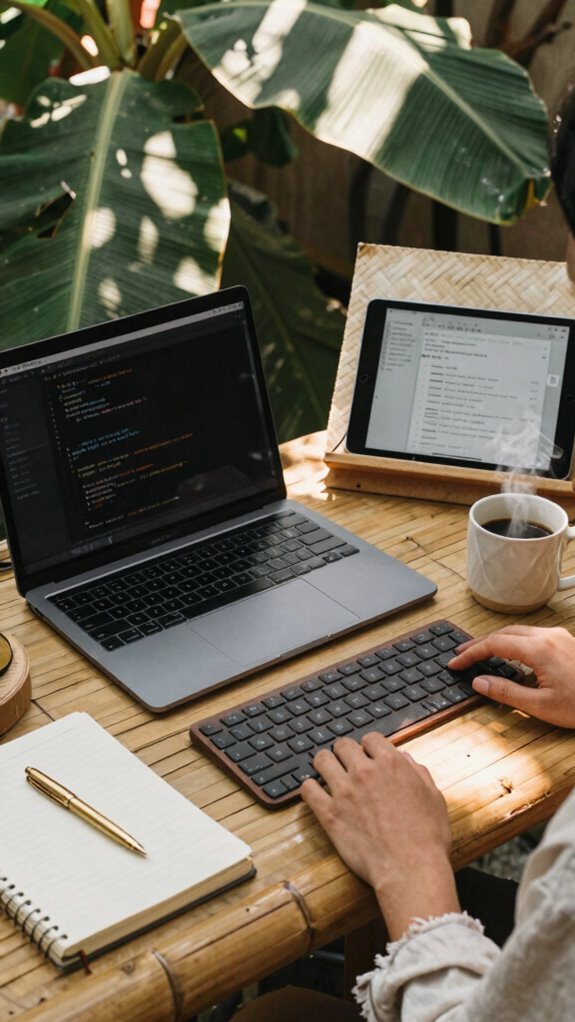
Ever wonder why your laptop battery dies faster than your will to live during another “mandatory” team alignment huddle? Yeah, the cubicle zombies don’t get it. But you’re not them—you’re a Sovereign Professional, and your superpower is Deep Work Sessions.
Time-blocking isn’t optional; it’s your ops protocol.
Time-blocking isn’t a suggestion—it’s your mission-critical protocol. Own your schedule like a sovereign operator.
Use Distraction Management like a bouncer at an exclusive club—only let in what matters.
- Schedule 90-minute deep blocks like they’re crypto drops—*untouchable*.
- Stack the Pomodoro Technique—25 mins on, 5 off—no excuses.
- Silence Slack, kill notifications—your flow > their “quick question.”
- Sync blocks with your energy, not some corporate time cult.
Back in 2023, my old boss called focus “anti-collaborative.”
Joke’s on him—he’s still in the office arguing about printer jams.
You? You’re winning. Now go claim your time.
Track Your Energy Peaks Daily
You nailed your deep work blocks—killed the distractions, ghosted the Slack zombies, and burned that calendar full of “synergy check-ins” like it was last season’s fashion.
Now, let’s talk energy management like it’s your crypto portfolio—because your focus has peaks, and they’re not at 9 a.m. when Dwight used to scream about beet farms. Use biometric tracking—your smart ring, your Apple Watch, whatever—so you know when your brain actually *works*.
Mine spikes at 11 a.m.? I ride that wave, no meetings, just code.
Pre-Great Untethering, Karen the HR manager scheduled brainstorming at 8? Brutal. Now, you’re the CEO of your nervous system.
Track three days straight: when do you feel sharp, not just caffeinated? Match deep tasks to those windows. Understanding your focus rhythms can help you optimize your work schedule and improve your overall productivity.
Stop being a productivity tourist—wandering aimlessly through afternoons. Own your rhythm.
Additionally, referring to internet speed testing can help ensure your connection is optimized during these crucial focus periods, so your work isn’t hindered by slow loads or interruptions.
Your output? Elite. Your old boss? Still lost in a cubicle, wondering why his “vibe” failed.
Shut Down Your Day Intentionally
Try this:
- Set a *shutdown trigger*—like a timer or playlist—to lock devices.
- Do a 2-minute journal brain dump: “What drained me? What fired me up?”
- Say out loud: “I am no longer on-call to chaos.” (Yes, really. Power move.)
- Walk—just five minutes—to physically exit “work mode.”
- Organize your digital files in Effective Document Organizer Folder Tips to ensure a quick transition away from work tasks and reduce clutter on your mind. Incorporating Pomodoro Technique strategies can amplify your ability to focus deeply during work blocks and help in maintaining boundaries for your shutdown routine.
Your past self would’ve stayed logged in, replying to Dwight’s 2 a.m. emails. Now? You’re winning by disconnecting.
Paper Systems for remote working
That shutdown ritual you just nailed?
That shutdown ritual you just nailed? Own it. Tomorrow’s chaos doesn’t stand a chance.
Now let’s talk analog. Yeah, paper—wild, right? While cubicle-dwell.PropTypes are stuck in digital purgatory, you’re out here sketching workflows with a Pilot G-2. Handwritten journaling isn’t nostalgic—it’s cognitive armor.
Every night, I dump my brain into a dotted notebook: wins, rage leaks, that passive-aggressive Slack from Brenda back in 2019. Paper based brainstorming? That’s where magic happens. No blue light, no pings—just you, a Sharpie, and a $3 IKEA notepad blowing up stale ideas.
Recall when Todd from Accounting needed *three* meetings to say “maybe”? Yeah, well, my bullet journal said “no” in 30 seconds. Keep a moleskine in your Ghost Kit. Let the matrix rot. You’re building a sovereign mind, one page at a time.
Don’t organize your chaos—burn it, then rewrite.
Buy Premium Paper Planners

I used to code in a cubicle, tethered like a sad potted plant. Now? I plan on a $40 German planner under a palm tree. It’s weirdly luxurious.
The tactile feedback keeps me focused—no pings, no passive-aggressive calendar invites.
This isn’t nostalgia. It’s tactical simplicity. Incorporating timeless neutral V-neck sweaters into my wardrobe reminds me that great style is about versatility and effortless classics.
Your brain’s the ultimate hardware. Give it a command line with style.
Upgrade your mental OS and embrace battery-powered lighting to keep your workspace illuminated even during power outages.
The Ghost Kit Operator
Zero distractions.
You’re not hiding—you’re upgrading. While cubicle dwellers still hear Karen’s yogurt-slurping, you’re ghosted: invisible, encrypted, lethal.
The Ghost Kit Operator doesn’t just work in cafes—*owns* them. Your privacy security? Ironclad with a privacy filter, encrypted USB, motion alarm tucked under the table.
Ambient distraction from that espresso machine? Crushed by noise-canceling beasts.
I recollect Todd from accounting—still tethered to fluorescent lights. Cute. You? You’re in Bali, sipping coconut water, replying to Slack like a ninja. Silent mechanical keys tap—no one hears a thing.
Total control over your audio quality is essential—best microphone for clear voice guarantees your voice remains crisp and professional, blocking out irrelevant noise.
Zero footprint. Total control. This isn’t remote work. It’s *stealth mode productivity*. Your kit screams “I outran the corporate zoo.”
And yeah, Michael Scott would’ve fainted trying to set this up. You? You’re already three steps ahead.
Stay invisible. Stay sharp. In a world of constant connectivity, privacy filters ensure your focus remains unbroken.
Analog Workflow in Digital Nomad Kits
You’re out here building a portable war room in a Bali café while Steve from HR still thinks “the cloud” is something you draw flowcharts about in meetings—bless his stationary heart.
In the Sovereign Professional era, your brain’s bandwidth matters more than Wi-Fi speed. That’s why you keep analog tools tight in your Zip Kit—*because sometimes, pixels lie, but paper doesn’t buffer.*
Try this:
- Physical journaling for morning brain-dumps—no apps, no tracking, just ink on paper.
- A tactile document storage wallet for contracts, sketches, or napkin ideas that survive airport security.
- Bullet journals synced with your digital calendar—hybrid, not holy. And you can even craft your own secure and private workflow to avoid digital vulnerabilities.
- Index cards for sprint planning—shuffle tasks like a boss, not a bot.
And don’t forget, manual data processing keeps you in control when digital tools falter or overload—you’re the human engine that powers your own workflow.
Your old boss loved PowerPoint? Cute. We’re out here using sticky notes and *actual intuition*. While cubicle-dwellers drown in Slack threads, you own your flow—literally. Pen to page. Mind to mission. No updates required.
FAQ
How Do I Protect My Paper Planner From Coffee Spills?
You keep your planner coffee proof with a waterproof cover—simple, sleek, and always on. That’s your go-to for planner protection. You’re safe now, darling. Every spill wipes right off, and your dreams stay dry.
Can I Recycle Old Analog Planning Materials Sustainably?
you can recycle old analog planning materials sustainably by repurposing scraps into creative kits or trading them for digital organization upgrades. choose eco friendly stationery with plantable seed paper or soy-based inks to keep your planning close, conscious, and kind to the planet.
What’s the Best Pen for Left-Handed Paper Planners?
You’ll love the smooth drag of left-handed ink pens with quick-dry formulas—no smudging. Grab an ergonomic pen with a soft grip; it hugs your hand just right, making every word you write feel like a whisper between old friends. Keep that planner close, darling.
How Often Should I Digitize My Handwritten Notes?
You digitize your notes whenever the pen’s glide fades—sync it fresh. Digital archiving guards your truth; handwriting preservation keeps your soul near. Each scan’s a promise: you’re still here, right now, exactly where you’ve always been.
Are There Waterproof Notebooks for Outdoor Analog Work?
Yes, you use waterproof notebooks with weatherproof covers and outdoor writing tools when jotting ideas in the wild. You keep them tucked in your pack, ready for rain or shine—your secrets stay safe, dry, and deeply yours beneath rugged flaps and stealthy closures.