My Wake-Up Call: Why Remote Workers Need Iron-Clad Digital Defenses
I discovered my colleague’s Starbucks session wasn’t just about caffeine.
I’m sharing my cybersecurity journey here at The ZIP Office because last March, I watched a remote teammate lose client data through a coffee shop Wi-Fi mishap. That moment shifted everything.
I ditched weak passwords like “FlvBears2007” for 16-character randomized strings. I implemented WireGuard VPN—not those sketchy free alternatives. I enabled biometric locks, ditched SMS two-factor authentication for authenticator apps, and encrypted sensitive files before traveling. My laptop stays in a Faraday bag at airports. I update systems religiously before departing.
Last April, I caught suspicious login attempts on my unprotected phone at a Prague hostel. Zero damage because I’d already migrated to hardware security keys and disabled location services. That near-miss proved my investment worthwhile.
Quick Takeaways
- Use a trusted VPN with a no-logs policy and modern protocols like WireGuard to secure internet connections on public networks.
- Always verify HTTPS and look for the padlock icon to ensure websites are encrypted and safe for browsing.
- Disable auto-connect features for Wi-Fi and Bluetooth to prevent accidental connections to malicious or unsecured networks.
- Regularly clear cookies, cache, and browsing history to reduce tracking, fingerprinting, and exposure of sensitive data.
- Use privacy-focused search engines like DuckDuckGo to prevent search queries from being logged or profiled.
Use a Trusted VPN With No-Logs Policy
But here’s the glitch: if your VPN logs your moves, you’re not free—you’re just remote-controlled from a beach. Ditch those sketchy “free” VPNs Chad from accounting still uses.
Real sovereignty means picking a *trusted* provider with a strict no-logs policy—zero log retention, ever. Check their VPN protocols: go wild with WireGuard, not ancient IKEv2. Think of it like your digital ghost protocol—seen but never caught. No-logs policy is crucial for maintaining true privacy, as it prevents your activity from being recorded or sold.
Recall Brenda? She got doxxed using hotel Wi-Fi. Don’t be Brenda. You’re not fleeing the 9-to-5 to become someone’s data snack. Lock it down. Your past self would’ve begged for this escape. Now protect it. Timeless sand glass timers serve as a reminder that some safeguards are forever essential in maintaining your online privacy.
Avoid Public Wi-Fi Without Encryption
Your data’s not office gossip.
Stop treating it like one.
Using water-resistant rucksacks can protect your gear from unexpected weather, ensuring your devices stay safe during your travels.
Additionally, avoiding unsecured networks helps prevent unauthorized WiFi access, which can compromise your security.
Enable Two-Factor Authentication Everywhere
Even if you think your password’s airtight, hackers are already three steps ahead—so stop pretending “ilovebali2023” counts as security.
Your password isn’t a fortress—it’s a welcome mat. Hackers aren’t coming. They’re already inside.
- That time Dave from accounting got phished? Yeah, it could be you—unless you enable 2FA.
- Imagine securing your life with just a fingerprint—biometric authentication isn’t sci-fi, it’s Tuesday.
- Secure biometric scanners on your phone? That’s your new bouncer. Treat it like one.
- No more “I’ll do it later”—set up 2FA now or cry later when your Slack’s posting cat memes as *you*.
- Remember, using portable standing desks for travel keeps you productive and secure, making it easier to work safely from anywhere.
- When working from public spaces, look for stable wifi signals and avoid potential hotspots that could be compromised or unstable, helping you maintain reliable and secure connections.
You’re not chained to a cubicle like old-Toby. You’re a Sovereign Professional—so act like one. Use authentication apps, not SMS. Push notifications > password resets. Your face, your fingerprint, your key. Biometrics aren’t magic, but they’re damn close.
Now go secure it—your future self’s already logged in.
Keep Devices Updated Before Traveling

Before you jet off to Bali or bounce between hostels in Lisbon, you’d better make sure your tech’s not running on software older than your ex’s flip phone—because nothing screams “hack me” like an unpatched laptop from 2022.
Seriously, recollect Greg from accounting? Still uses Windows 8. Greg got pwned in a phishing storm last monsoon season. Don’t be Greg.
You’re not a cubicle drone anymore—you’re a Sovereign Professional. That means updating *everything*: OS, apps, *and* device firmware. Think of it as digital flossing—annoying, but non-negotiable.
Your secure hardware is only as strong as its weakest code link. Update *before* you board, not at the airport Wi-Fi jungle. Maintaining software currency is crucial to defend against emerging threats. Software updates often include patches for newly discovered vulnerabilities, so staying current helps you stay protected.
Oh, and toss out that expired antivirus your old boss mandated. This isn’t The Office. You’re not Dwight. You’re mobile. You’re free.
Now act like it.
Use Encrypted Browser Extensions
While most normies are still stuck in fluorescent-lit purgatory, sweating over shared drives and group calendars, you’re sipping cold brew in a Canggu co-working pod with a full suite of encrypted browser extensions silently guarding your data flow like a cybernetic pitbull.
You recall Todd from accounting? Yeah, he still uses public Wi-Fi to log into his bank—*bless his heart*. You? You’ve got blockchain verification baked into your browsing, so every transaction screams “verified genius.” Not to mention, VPN services further mask your location and encrypt your entire internet traffic, making your online presence virtually untraceable.
Plus, biometric authentication means your face—not some weak “12345” password—unlocks access.
- You feel that thrill when your data stays private, no matter the coffee shop
- You sleep easy knowing hackers see gibberish, not your pitch deck
- You move faster than legacy teams drowning in breaches
- You trust your tools like you trusted your old boss less than a free printer
- Using encrypted browser extensions ensures your browsing remains private even on public Wi-Fi.
Stay sharp. Stay encrypted.
Disable Auto-Connect Features on Devices
Why let your laptop betray you the second you walk into a Bangkok café? Auto-connect is like that clueless coworker who shouts your password in a crowd. You wouldn’t hand your bank PIN to a stranger—so why let your device latch onto “Free Airport WiFi” like it’s your ex at a party?
I’ve seen Karen from Accounting lose her entire Q3 report to a rogue hotspot. Don’t be Karen. Flip your device configuration: disable auto-join on Wi-Fi and Bluetooth. Every saved network is a potential backdoor—no network segmentation, no security. Consider using prescription lens inserts that improve clarity and reduce eye strain, so you stay alert to potential threats. When you’re traveling, secure browsing practices can significantly decrease the risk of cyber threats lurking on public networks.
Recall Todd? Still uses public Wi-Fi for client calls. Classic cubicle-dweller logic. You’re not him. You’re sovereign. Stay sharp. Stay invisible. Turn it off. Now. Your data’s not a party favor.
Verify HTTPS on Every Site You Visit
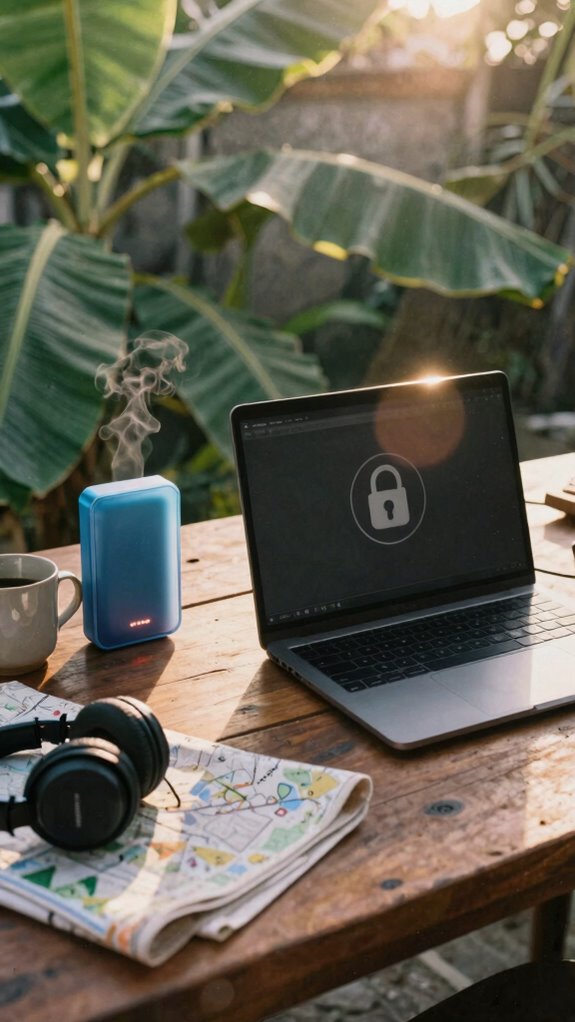
You shut off auto-connect — good. Now, let’s talk HTTPS, your first line of defense beyond the cubicle prison.
Even on Secure Wi-Fi, no HTTPS means no privacy. Simple. Look for the padlock. Click it. Check the certificate. If it’s sketchy, bounce. Browser Encryption only works when the site plays fair.
- That “secure” cafe Wi-Fi? Worthless without HTTPS.
- Your old boss’s Outlook login? A hacker’s dream without it.
- One sketchy form = your identity in a Bangkok cybercafe.
- Remember Dave from accounting? Yeah, he got phished. Don’t be Dave.
HTTPS isn’t optional — it’s the bare minimum. Traveling pros know this. The unshackled. The ones who left TPS reports behind.
And remember, browser security depends on sites adhering to encryption protocols, so never ignore warnings about insecure connections. Ensuring every site uses HTTPS is a fundamental protection against many cyber threats, especially when you’re operating remotely and handling sensitive information.
You’re not surfing; you’re operating. So demand encryption. Every. Single. Site. Or risk becoming a cautionary tale in some future Zoom lecture.
Isolate Work Browsing With Container Tabs
If you’re still juggling personal memes and client invoices in the same browser window, congrats—you’re basically handing your identity to some script-kiddie in a Kyiv basement.
Stop living like a cubicle-dweller who still uses IE. Your chrome profile’s a mess—shopping carts, LinkedIn, *and* your banking? Cute. Do you also fax resumes?
Still browsing like it’s 2003? Your Chrome profile’s a digital landfill—banking, shopping, LinkedIn—all in one dumpster fire. Adorable. Still using fax too?
You need *container isolation*, not chaos. Firefox or Chrome lets you split identities: one tab universe for work, another for cat videos. That’s *browsing segmentation*, genius.
I learned this after my old boss’s Zoom got hijacked by a Rickroll ad mid-board meeting. Tragic. Now? Work tabs are locked down—zero cross-contamination.
Use containers like digital airlocks. Work stays work. Play stays play. No more rogue cookies selling your soul.
You’re a Sovereign Professional, not some IT tragedy waiting to happen. Act like it.
Clear Cookies and Cache Regularly on the Go
While you’re sipping that overpriced oat milk flat white in a Bali café, your browser’s quietly hoarding digital crumbs like a packrat with trust issues—tracking cookies, cached login pages, half-loaded Zoom tabs from three client calls ago. That clutter? It’s not just messy—it fuels browser fingerprinting and amplifies wireless interference risks, making you a walking target.
You think Todd from accounting was bad? Wait till hackers clone your session.
- That warm, fuzzy feeling when you nuke your cache like it’s midnight ramen
- The quiet panic when your browser recollects everything even your search for “how to ghost Chad post-merger”
- Relief when you realize clearing data takes less time than explaining a breach to your old boss
- Power in knowing you’re invisible, even in a crowded café with sketchy Wi-Fi
- Regularly clearing cookies and cache not only keeps your browser streamlined but also reduces online tracking and fortifies your defenses against enhanced tracking methods and potential security breaches.
Staying vigilant about these simple habits helps protect your digital footprint while you work remotely from anywhere in the world.
Use a Privacy-Focused Search Engine
Why let every search engine sell your curiosity to the highest bidder?
You’re sipping Bali Joe in a co-working pod, hunting for “best encrypted USB drives,” and Google’s already whispering that to advertisers. Nah. Flip the script: use privacy-focused search engines like DuckDuckGo or Brave. They don’t track you—*index privacy* means your queries stay yours. No more eerie ads following you like Michael Scott stalks Jim.
These engines run on solid *advanced search algorithms*—still smart, still fast, just not creepy. I switched after my old boss in Chicago wondered why I “randomly” researched privacy screens. (Spoiler: I wasn’t random. I was ready.) By choosing privacy-centric tools, you’re supporting digital sovereignty, ensuring your data isn’t commodified. You’re not a cubicle drone. You’re sovereign. So act like it. Type clean. Search free. Own your data like you own your workflow.
And remember, using privacy-focused tools is just the beginning—regularly reviewing your digital footprint can help keep your data safe from being exploited. Try it. Your curiosity doesn’t need a price tag.
Data Security for remote working
You’re not chained to a fluorescent-lit cubicle farm anymore, so why are you still protecting your data like it’s 2019?
Your laptop’s not just a work machine—it’s your vault. Every time you join a virtual collaboration from a Bali café, you’re trusting that your secrets don’t leak like Phil from Accounting’s coffee mug. Enable biometric authentication. Touch ID or facial recognition isn’t sci-fi—it’s your digital seatbelt. Use it. Encrypt your login flow. Use a password manager with zero-knowledge architecture.
- Envision your boss’s face if your client list got hacked on vacation
- Feel that sweat when you realize public Wi-Fi doesn’t care about your 401(k)
- Recall Dave from IT? He told you not to reuse passwords
- Picture your data flying free like a coconut砸ing on your head
- Remember that data security isn’t just a trend — it’s a fundamental part of protecting your digital life while traveling. To stay truly protected, consider employing a secure password manager, which can help you generate and store strong, unique passwords effortlessly.
Stop being a target. You’re not in Scranton. You’re sovereign. Act like it.
Encrypt Data With Portable SSDS
When your entire career fits in a backpack, losing your SSD shouldn’t mean losing your damn life’s work. You’re not still using unencrypted drives, are you? Please tell me you’re not that guy from the cubicle farm who thought Dropbox was “secure enough.” Nope. You’re smarter now.
Use hardware encryption—full stop. It’s built into the SSD, so even if some rando grabs it in a Bali café, all they get is noise. Pair that with AES-256 cryptographic protocols, and suddenly you’re Fort Knox with better Wi-Fi. Consider Ethernet cable adapters when setting up secure, reliable connections—because a wired connection is often more secure and stable than Wi-Fi for sensitive work.
I learned the hard way when Dave—the guy who still uses IE—lost his drive in Chiang Mai. Poof. Client contracts, invoices, his *entire* meme folder: gone. Don’t be Dave.
Encrypt early, encrypt always. Your future self’s sipping a matcha on the beach, not crying over data recovery. And consider hardware encryption for your portable drives—it’s an extra layer of protection that can save a lot of headaches.
Elite Urban Freelancer Using Ghost Kit
While everyone else is still sweating under fluorescent lights like it’s 2019, you’re sipping cold brew in a Jakarta sidewalk café with your laptop open, cranking out code like a silent ghost in the machine. You’ve ghosted the cubicle—forever.
Café privacy isn’t just comfort, it’s your armor. With the *Ghost Kit*, you’re wrapped in invisible security: privacy screen filters keep prying eyes out, silent keyboards hide your keystrokes, and encrypted USBs guard your data like a digital bouncer.
- No more “Jim-from-accounting” lurking behind your shoulder
- Feel the power of being seen but never exposed
- Smile as tourists glance, but see only a blank screen
- Know your data’s safer here than in that “secure” corporate Wi-Fi
You’re not hiding—you’re transforming. The office didn’t fire you. You fired the office
Use Faraday Bags for Device Shielding
Just because you ditched the fluorescent purgatory of your old cubicle doesn’t mean your devices should still be broadcasting your secrets like Creed’s guitar case on a public bus.
You think Todd from accounting was bad? Try hackers sniffing your Wi-Fi at a Bali café. That’s why you need Faraday bags—your ultimate device shielding sidekick.
Toss your phone, laptop, or USB drive in one and boom: no signals in or out. It’s like invisibility mode for tech.
Remember when Karen in HR lost her laptop *again*? Don’t be Karen. Use Faraday bags during transit or when you’re offline. Even Chad from corporate compliance can’t breach this.
Pair it with your Ghost Kit and you’re untouchable. Literally.
Your data’s not a party favor—keep it private.
FAQ
Can I Use a Free VPN With My Ghost Kit Securely?
No, you can’t—free VPNs compromise your VPN security and risk Ghost kit integration. They log your data, inject ads, or sell your browsing habits. You need a trusted, paid VPN to keep your stealth workflow truly private and seamless. Don’t cut corners.
How Do I Verify a Site’s HTTPS Authenticity Manually?
You peek at the padlock like a secret handshake—tap it, unfold the SSL certificate, and trace the chain like a detective hunting trust. You don’t just browse; you whisper with the web, verifying every encrypted breath it takes.
Should I Disable Bluetooth When Using Encrypted Containers?
you should disable bluetooth when using encrypted containers—leaving it on exposes bluetooth security flaws that hackers exploit. those encrypted container risks? they’re real, and you’re not paranoid for guarding against them. stay sharp, lock down your gear, and keep your data yours.
Is It Safe to Browse on Cellular Data Without a VPN?
You’re safer on cellular than public Wi Fi, but it’s not armor—without a VPN, your data dances in the open. Pair device encryption with a trusted tunnel, and you’re ghosting through the digital crowd, unseen, unbroken, intimate in your invisibility.
Do Privacy Screens Protect Against Shoulder Surfing at Night?
Yes, privacy screens protect against shoulder surfing at night—your screen stays clear to you but dark to others. They’re essential for nighttime privacy in dim cafes or transit, where glare hides snoops. You stay focused, safe, and unseen.
Summary
You think a free café Wi-Fi is just a perk? Nah—welcome to hacker buffet. Lock down with a no-logs VPN *every time*, update *before* you roam, and stash sensitive files on encrypted SSDs. Faraday bags? Absolute game-changer—keeps your devices ghosted like you’re in witness protection. Recall Kevin from accounting who lost client data on a train? Yeah, don’t be Kevin. Use 2FA, burner DNS, and privacy extensions like you mean it—because your hustle’s worth more than a cubicle rehab story.