Elevating Virtual Presence: My Journey from Pixelated Disasters to Polished Professionalism
How do I transform forgettable video calls into magnetic moments? I’ve learned it’s about deliberate environmental design and technical precision.
I write to The ZIP Office because remote work demands authenticity—something I discovered the hard way at my 2019 startup gig.
I ditched my 2010 MacBook webcam. Invested in a 4K Logitech camera. Positioned it at eye level. Added warm Nanoleaf RGB panels behind me. My Rode NT1 mic eliminated background chaos. When I presented quarterly analytics to executives last March, nobody asked “Can you hear me?”
Last Tuesday, I noticed my colleague Marcus still using his laptop’s built-in mic during client pitches. His audio clipped. I recommended USB condensers. Within weeks, his Zoom recordings sounded broadcast-quality. That’s when remote presence clicked—it’s about respecting your audience’s attention span.
Quick Takeaways
- Maintain eye contact by looking directly into the camera to foster engagement and authenticity.
- Use professional lighting and a distraction-free, minimal background to ensure a polished appearance.
- Utilize high-resolution cameras and noise-canceling microphones for clear, lifelike audiovisual communication.
- Incorporate holographic or immersive technologies for 3D presence, enhancing realism and interactivity.
- Optimize your environment with sound-absorbing materials and balanced lighting to reduce strain and improve visual fidelity.
What Are the Core Principles of Lifelike Remote Presence?
Patience isn’t optional—wait your turn, avoid that annoying overlap. Eye contact? Look into the camera—your new best friend. Environment matters, so ditch distractions—bright, distraction-free spaces for that “top-tier CEO” vibe. Dress sharp, mute yourself when not talking, and use bold speech—no “maybe” or “kinda.” Switches can help ensure your setup is top-notch and reliable. Regularly testing your email filters helps prevent technical issues during crucial moments. Master these, and you’ll stomp those cubicle drones in lifelike remote prowess.
How Can You Design Your Space for Seamless Virtual Meetings?
| Aspect | Power Move | Example |
|---|---|---|
| Lighting | Front-facing, soft, natural or warm LED | Facing window with curtains |
| Background | Clean, professional, distraction-free | Shelves with minimalist decor |
| Tech Setup | Stable internet + quality camera & mic | Monitored, wired connection |
| Acoustic Environment | Incorporate sound-absorbing materials to reduce echo and enhance audio clarity | Adding acoustic panels or rugs can greatly improve sound quality during virtual meetings |
Essential Tech for High-Fidelity Virtual Collaboration
If you’ve ever sat through a Zoom call that looked like it was shot through a potato, you know tech matters—especially when going for high-fidelity collab. You’re not here to settle for “meh” visuals and audio. Invest in a decent webcam—like 1080p or better—and place it at eye level; it’s all about that natural connection, not making others feel like they’re talking to a shadow.
Use noise-canceling mics so your voice comes through clear, no background chaos. Make sure your Wi-Fi’s rock solid; the last thing you want is lag, right? Hack your setup: lighting from the front, dual-monitors for multitasking, and high-res screen sharing. Additionally, employing a smart ring charger can ensure your devices stay powered throughout long virtual meetings, preventing interruptions caused by dead batteries. Enhancing your video quality setup can also make a noticeable difference in creating a lifelike virtual presence.
Trust me, this is what separates pros from pretenders in the remote game.
How to Optimize Lighting, Camera, and Sound for Natural Interaction

Ever sat through a virtual meeting where the host looks like they’re trying out for a ghost movie? Yeah, we’ve all been there—pixelated, shadowy, totally disconnected.
Here’s the power move: light yourself like a Hollywood star. Position a soft light source directly in front of you—think ring light or a well-placed lamp. No backlighting, please—that’s an easy way to say “I’m clueless.”
Raise your camera to eye level—no, nobody wants to look down on your nose or up your nostrils. Test your setup, tweak until clear and bright.
Ask, “Does my face look alive or dead?” If the answer’s dead, fix it. Keep in mind, you’re trying to command attention, not scare people away.
For ultimate clarity and a natural glow, consider incorporating daylight therapy lamps—they can provide a balanced, lifelike lighting environment even indoors. Proper lighting can also reduce eye strain from screens — a common problem during long virtual sessions.
Level up—own that lighting, camera, and sound game.
Choosing the Right Holographic and Immersive Telepresence Products
Thinking about jumping into holographic and immersive telepresence gear? Why settle for boring video calls when you can command the room with a lifelike digital avatar? Do you want to seem like the future boss? You’ll need the right stuff: volumetric displays make your “presence” real, while spatial audio makes your voice feel like it’s coming from the hologram itself.
Real-time capture hardware? Essential, so your gestures are flawless—no lag. And don’t forget the software—powerful telepresence platforms that actually get your emotions across.
- Experience the awe of volumetric 3D visuals—like your own hologram squad.
- Crank up presence with directional audio—like you’re there, not just a pixel.
- Equip high-speed hardware for glitch-free motion—because lag is for office drones.
- Choose software that makes you look like a digital rock star, not a YouTube amateur.
And to ensure the experience remains seamless, consider merging multiple internet connections for extra bandwidth and stability—especially vital for real-time, high-quality telepresence sessions.
Best Practices to Boost Engagement & Professionalism in Virtual Events
When it comes to virtual events, simply showing up with your camera on and mumbling through slides isn’t going to cut it anymore—your audience needs more. Think about it: are you truly engaging or just ‘recording your lecture’?
To level up, prep visuals that pop—use high-res screens, sharp lighting, and a clean background. Speak with authority — muscular phrasing helps. Use your mic discipline: mute when not talking, eye contact by looking into the camera.
Don’t be that person scrolling through emails; pack your energy and confidence. Drop clichés, bring clarity, and toss in a dash of humor. Don’t let your team see you in pajamas or fumbling around — they want sleek, professional power.
Use chat or reactions, make it dynamic, and recall: you’re hosting, not just attending. Remembering working across multiple time zones can help you better plan your engagement strategies for international audiences.
Additionally, understanding the importance of digital security and privacy, such as protecting your online presence, can ensure a safer and more professional virtual environment.
Attending Holographic Meetings
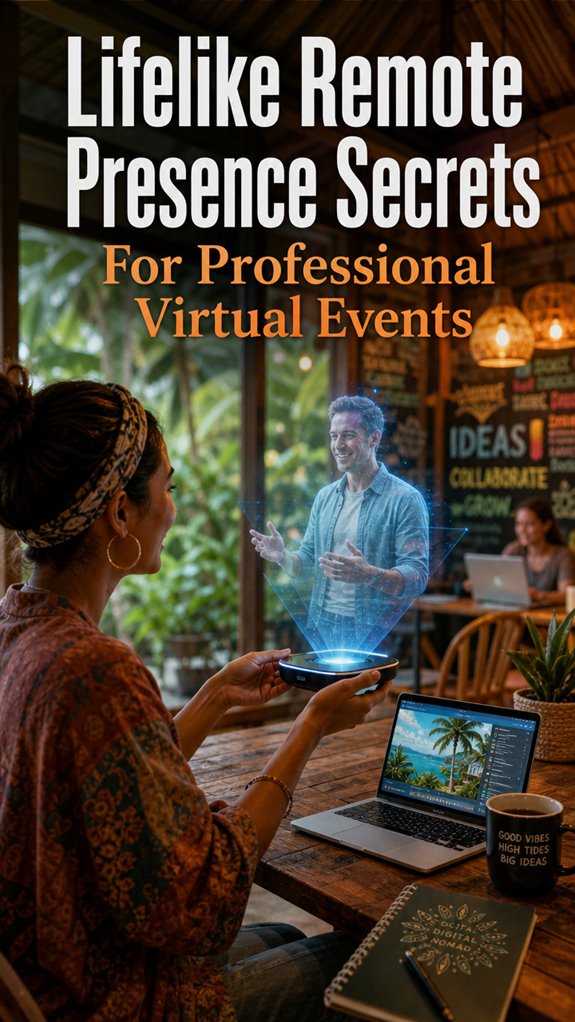
Jumping into a holographic meeting feels like stepping into a sci-fi flick—except it’s real, and if you’ve got your setup right, it’s seamless. Think high-res volumetric displays projecting your full body in 3D, floating right in the room. No headset needed—just pure power.
But here’s the kicker: mastering this game means prepping your environment like a pro.
- Surround yourself with calibrated lighting; soft, front-facing light is king.
- Position your camera at eye level—most of those “great visual contact” tips aren’t optional anymore.
- Use spatial audio for that real-world vibe—sound from the right direction keeps you in control.
- Keep your hardware lean but killer—think high-def capture devices and low-latency networks.
- The right VR setup can significantly enhance your holographic presence and make virtual interactions more engaging.
- To optimize your experience, it’s essential to understand the full-body projection capabilities and limitations of your holographic system.
This isn’t just tech hype. It’s about owning your presence, even across the void.
Holographic Display Purchase Options
If you’re eyeing a holographic display setup that doesn’t scream “Gamer Nerd,” you’re in luck—there are legit options that don’t require you to sell your kidney or move to a Silicon Valley startup.
Today’s holographic tech is sharp, powerful, and surprisingly user-friendly. Think about volumetric displays like Looking Glass or portables from companies like HoloPresence—these plug-and-play marvels give you rich 3D visuals right on your desk.
Just keep in mind: high-res isn’t necessarily better if your bandwidth tanked like a dial-up, so balance resolution with your connection stability. As advancements in brain-computer interface technology continue, integrating neural controls could soon make these displays even more intuitive.
To truly elevate your presentations, look for systems with hologram resolution that ensures crisp, clear visuals even from different viewing angles.
Want to impress clients? Opt for units with built-in spatial audio, multi-view tech, and support for real-time gesture controls.
Skip the headache, grab a system that’s future-proof, and tell your old boss to finally take remote meetings seriously.
Virtual Office Setup
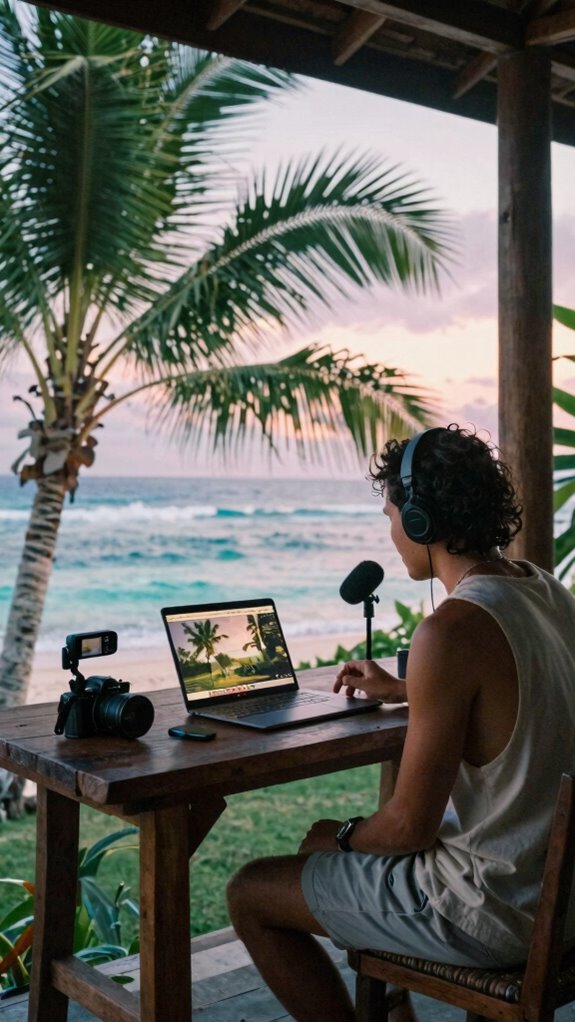
Getting your virtual office setup dialed is basically your ticket to thriving in the age of Sovereign Professionalism—because let’s face it, those snooze-worthy cubicles are dead, and everyone’s craving the freedom to work from anywhere (yes, even Bali’s buzzing co-working scene).
Want to boss up? Focus on:
- High-speed internet—a must-have; nothing kills momentum like lag. Think satellite setups or 5G modems.
- Powerful hardware—fast laptops, portable displays, and noise-canceling headphones so you can switch from surf to strategy in seconds.
- Smart lighting + camera gear—so your virtual presence commands respect, not “who’s this tourist?” vibes. Elevating your virtual professionalism with suitable equipment can make all the difference.
- Secure tools—encrypted drives and VPNs to keep your boss’s secrets locked tight, unlike those old office servers.
The goal? Create an ecosystem that screams “professional prime,” even in flip-flops. Plus, understanding the Velocity Kit can enhance your remote setup with real-time mobility and precision.
Emerging Holographic Telepresence Technology
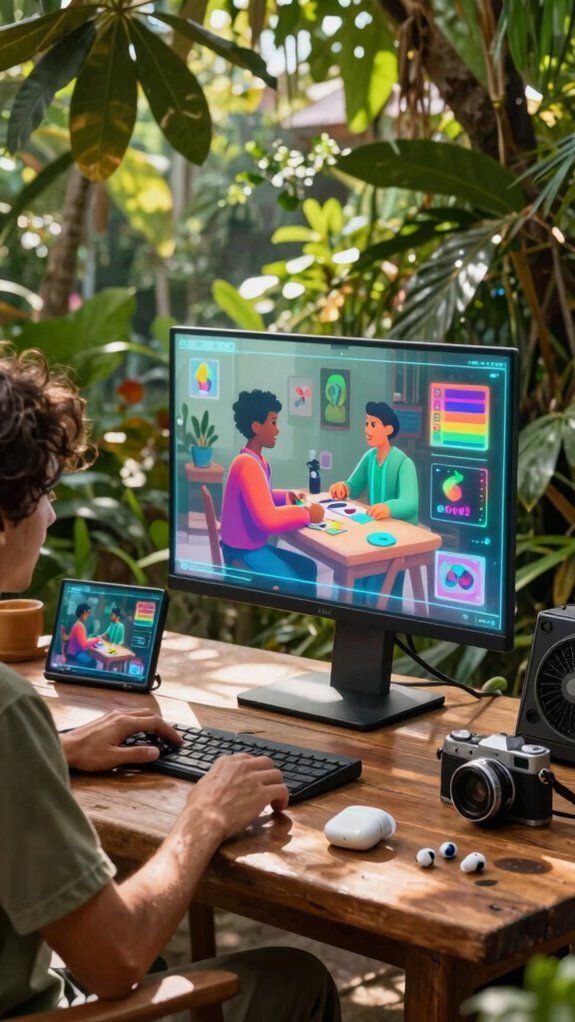
As I sit here in Bali’s buzzing co-working spot, I can’t help but marvel at how rapidly holographic telepresence is transforming remote work, making those tired Zoom calls look ancient. Recall those freeze frames during meetings with Bob’s head spinning? Yeah, gone.
Holographic tech pulls off lifelike 3D images that hover in your room, no headsets needed—think sci-fi but real. Want to boss a virtual meeting with a 3D version of yourself? Easy.
Grab a volumetric display, hook it to a powerhouse GPU, and sync with advanced spatial audio. Just like old colleagues from the corporate grind, you can now dazzle clients or host team huddles in a way that screams ‘power move’. Improving the visual fidelity of these holograms is becoming increasingly accessible with innovations in display tech.
Seriously, why settle for pixelated faces when you can wield the future? Modern holographic glasses kits make these stunning visuals a reality, elevating remote interactions to an entirely new level.
FAQ
How Do Latency Issues Impact the Realism of Holographic Meetings?
Latency kills hologram realism faster than your boss’s endless Zoom prompts. Under 100ms? Perfect—delays causing lag make those stunning 3D figures jerk like a bad puppet show.
You want seamless presence, right? So, global fiber optics and high-performance GPUs are your BFFs.
Think about it—when latency spikes, your hologram’s like a static-filled TV, and even Ming from accounting looks suspiciously robotic.
Don’t settle for “close enough”—push for real-time magic.
What Are the Compatibility Considerations for Different Telepresence Hardware and Software?
Think of telepresence hardware and software compatibility like trying to sync vintage vinyl with a Bluetooth speaker—chaotic, right? You must check if your holographic displays (like volumetric 3D units) play nice with XR platforms and real-time engines.
Ensuring low latency, seamless gestures, and visual clarity is crucial. Recall my old boss’s failed launch? Mismatched gear kills immersion. Match specs, test connections, and choose open-source tools that flex with each other.
No shortcuts.
How Can Remote Participants Ensure Consistent Eye Contact With Holographic Displays?
Want to stay on point with holographic eye contact? Position your monitor at eye level and stare right into the camera lens—think of it as bobbing your head like a puppet master.
Practice in your Bali co-working space, not on the first Zoom, and test lighting so your hologram isn’t a ghost.
Keep in mind, old boss’s rule: fake it till you make it—just don’t ghost your hologram buddies!
What Security Protocols Are Essential for Holographic and Virtual Collaboration Platforms?
Think of your hologram like the secret sauce—without proper security, it’s a free-for-all. Use encrypted channels for data, multi-factor authentication, and role-based access.
Implement end-to-end encryption, multi-layer firewalls, and regular security audits.
Don’t be that person leaving doors open like old boss introducing “uncle Bob” to new staff.
Keep in mind, in Bali’s co-working scene, securing your virtual lounge is like locking your scooter—necessary if you care about your power.
How to Troubleshoot Common Technical Failures During Holographic Remote Presence Sessions?
Got glitchy holograms or lag? First, double-check your high-speed fiber—are you throttling bandwidth or still battling VPN déjà vu?
Test your cameras and sensors—maybe your infrared dudes got lazy.
Restart your GPU clusters or update drivers—tech probs love a good reboot.
And don’t forget, if your spatial audio sounds like a bad karaoke night, recalibrate those directional speakers stat.
Basically, treat tech issues like a Netflix binge—fix quick, move on, don’t overthink.
References
- https://www.linkedin.com/pulse/web-conferencing-guidelines-new-era-telework-brian-fountain
- https://globalcareers.brandeis.edu/blog/2024/02/15/the-3-ps-of-virtual-meetings-presence-practice-patience/
- https://explore.zoom.us/docs/doc/Building-Presence-Webinar_Handout.pdf
- https://www.azoai.com/news/20250922/ETRI-Launches-XR-Telepresence-Tech-To-Enable-Real-Time-Handshakes-And-Lifelike-Remote-Meetings.aspx
- https://superstaff.com/blog/mastering-virtual-meeting-etiquette/
- https://www.linkedin.com/posts/marierios_mtreventdesign-mtreventstruggle6-eventplanning-activity-7452839802238042113-zhJT
- https://hr.emory.edu/eu/_includes/documents/sections/work-life/maintaining-virtual-presence.pdf
- https://www.linkedin.com/pulse/how-strengthen-your-virtual-presence-tips-online-meetings-weinman-zpzye
- https://www.microsoft.com/en-us/research/wp-content/uploads/2022/05/Workshop-2022-SocialPresenceInVirtualEventSpaces.pdf
- https://www.youtube.com/watch?v=6INmt_lowmc